Mammanindia
Gold just lost more than 3% but the interesting part isn't the drop itself. XAU/USD extended Friday’s Jackson Hole selloff into Monday, briefly slipping below $4,400 and touching around $4,396 as markets repriced the Fed path after Kevin Warsh’s hawkish inflation comments. September rate-hike odds have moved toward roughly 58–60%, while the dollar remains near a two-week high. That changes the short-term gold equation. For weeks, the trade was simple: weaker dollar + easier Fed expectations = stronger gold. Now we're seeing the inverse. Higher yields are increasing the opportunity cost of holding a non-yielding asset, while the stronger dollar adds another layer of pressure. At the same time, geopolitical risk is sending oil above $90, creating an unusual problem for gold bulls: safe-haven demand supports gold, but higher energy prices can reinforce inflation and keep the Fed hawkish. Technically, $4,467 is the level I'm watching. Gold is trading below that area after losing the 200-day average, with $4,408 acting as the immediate downside pivot. A failure to reclaim $4,467–$4,511 keeps the short-term structure bearish. My setup: Bearish: rejection around $4,450–$4,500 → target $4,408, then $4,368–$4,350 over the coming days. Bullish: reclaim and hold above $4,511 → the bearish repricing starts losing credibility, opening a move back toward $4,540–$4,580. Invalidation: sustained reclaim above $4,600. The real catalyst now isn't another Fed speech. It's the US jobs report. If employment weakens enough to unwind September hike expectations, gold could reverse aggressively. If the data keeps the Fed hawkish, that $4,400 shelf may not hold. Gold isn't necessarily bearish long term. The market is simply repricing the cost of owning it right now. #ByXIMPACT $XAUTUSDT #IMPACTbyTrade

SpaceX Is Approaching a Level That Could Decide the Next Move $SPCX is back around $155 after recovering from the September 15 low near $143. The stock closed at $154.72 on September 22, but the rebound is now approaching the $158–$160 area, where sellers have recently appeared. The fundamental backdrop is getting more interesting. SpaceX reported $7.8B in Q2 revenue, up 92% YoY, driven by continued growth in Starlink and its expanding AI business. NASA also awarded SpaceX another $946M for three additional crew missions, taking the total value of its contracted astronaut-flight program to $5.92B through 2030. But there are two immediate catalysts investors need to watch. Starship Flight 14 has been pushed to no earlier than September 28, with the mission planned to deploy 26 Starlink V3 satellites and attempt Starship's first orbital flight. At the same time, SpaceX President Gwynne Shotwell disclosed a proposed sale of about 342,170 shares worth nearly $52M, creating a potential short-term supply overhang. That creates an interesting setup. My setup: - Bullish: reclaim and hold $158–$160 with strong volume $\rightarrow$ $170$, then $180$. - Bearish: rejection around $158–$160 and loss of $150 \rightarrow$ $143$, followed by $135$. - Invalidation: sustained acceptance above $180$ would significantly strengthen the continuation thesis. The interesting question isn't whether SpaceX has enough catalysts. It's whether Starship execution, Starlink growth and the emerging AI business can translate into measurable financial growth fast enough to justify the premium investors are already assigning to SPCX... #ByXIMPACT $XAUTUSDT $SPCXXUSDT #IMPACTbyTrade
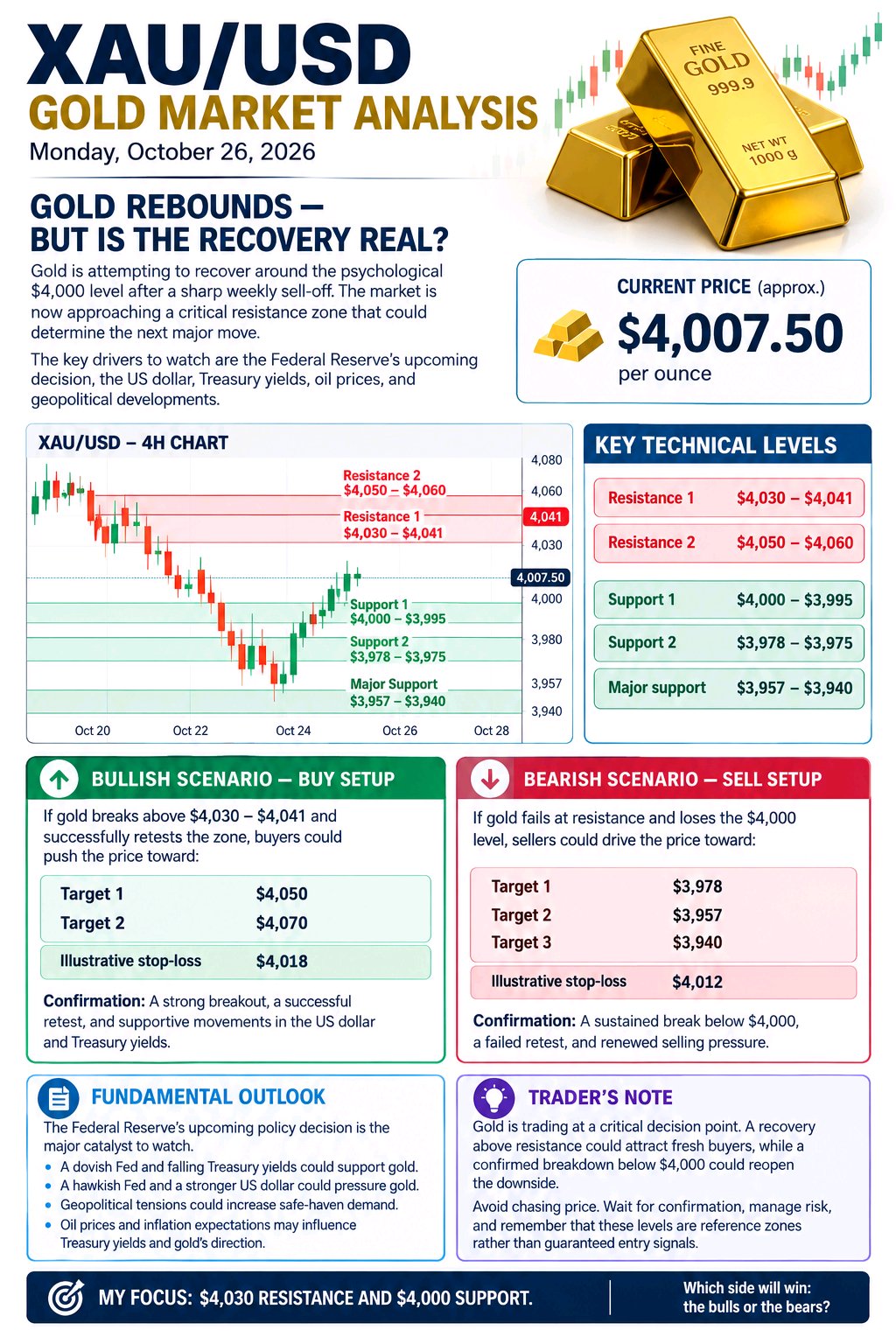
GOLD REBOUNDS — BUT IS THE RECOVERY REAL? Gold is attempting to recover around the psychological $4,000 level after a sharp weekly sell-off. The market is now approaching a critical resistance zone that could determine the next major move. The key drivers to watch are the Federal Reserve's upcoming decision, the US dollar, Treasury yields, oil prices, and geopolitical developments. KEY TECHNICAL LEVELS Resistance 1: $4,030–$4,041 Resistance 2: $4,050–$4,060 Support 1: $4,000–$3,995 Support 2: $3,978–$3,975 Major support: $3,957–$3,940 BULLISH SCENARIO — BUY SETUP If gold breaks above $4,030–$4,041 and successfully retests the zone, buyers could push the price toward: Target 1: $4,050 Target 2: $4,070 Illustrative stop-loss: $4,018 Confirmation: A strong breakout, a successful retest, and supportive movements in the US dollar and Treasury yields. BEARISH SCENARIO — SELL SETUP If gold fails at resistance and loses the $4,000 level, sellers could drive the price toward: Target 1: $3,978 Target 2: $3,957 Target 3: $3,940 Illustrative stop-loss: $4,012 Confirmation: A sustained break below $4,000, a failed retest, and renewed selling pressure. FUNDAMENTAL OUTLOOK The Federal Reserve's upcoming policy decision is the major catalyst to watch. - A dovish Fed and falling Treasury yields could support gold. - A hawkish Fed and a stronger US dollar could pressure gold. - Geopolitical tensions could increase safe-haven demand. - Oil prices and inflation expectations may influence Treasury yields and gold's direction. TRADER'S NOTE Gold is trading at a critical decision point. A recovery above resistance could attract fresh buyers, while a confirmed breakdown below $4,000 could reopen the downside. Avoid chasing price. Wait for confirmation, manage risk, and remember that these levels are reference zones rather than guaranteed entry signals. MY FOCUS: $4,030 RESISTANCE AND $4,000 SUPPORT. Which side will win: the bulls or the bears?$XAUTUSDT #ByXIMPACT #IMPACTbyTrade #MyByXTake
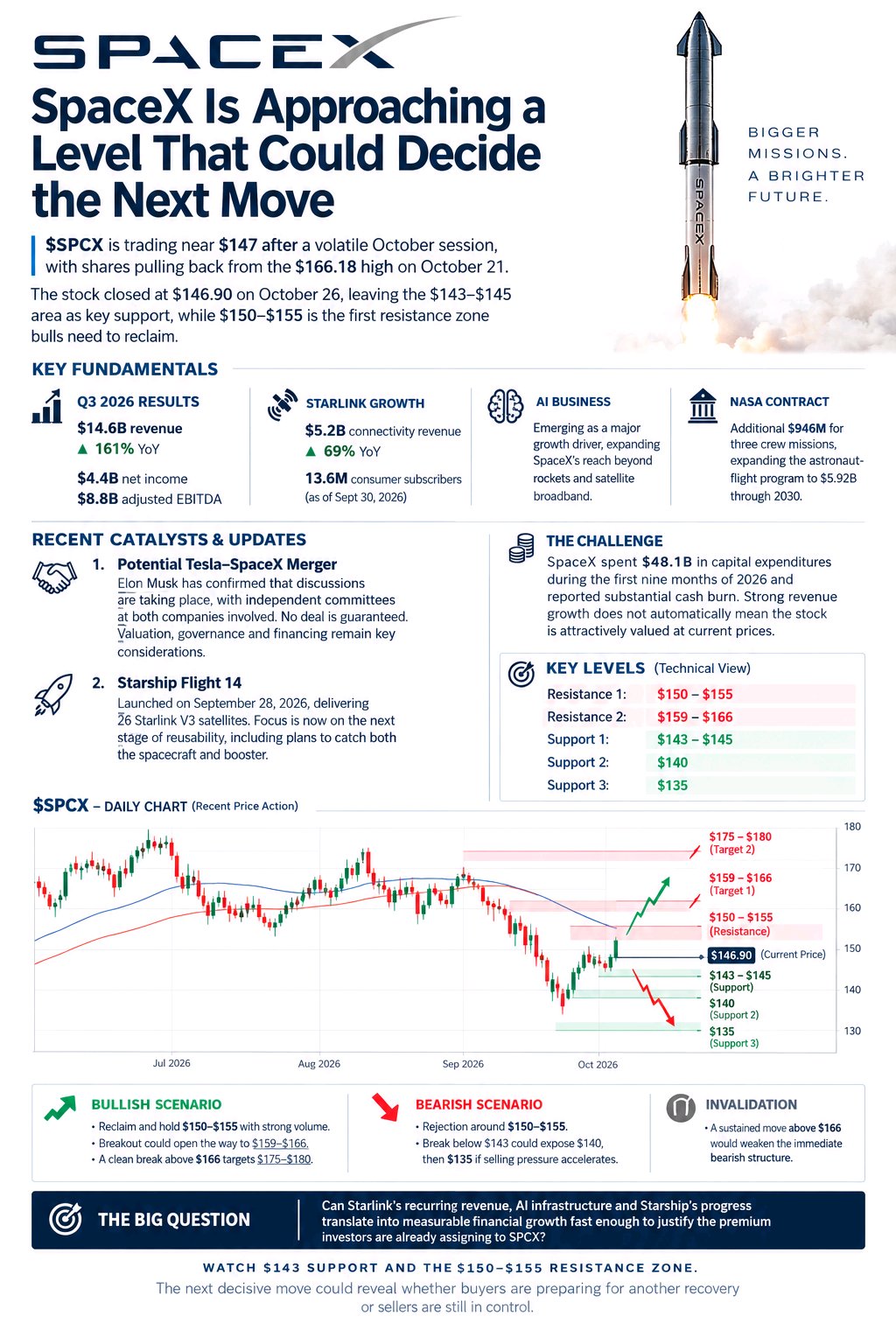
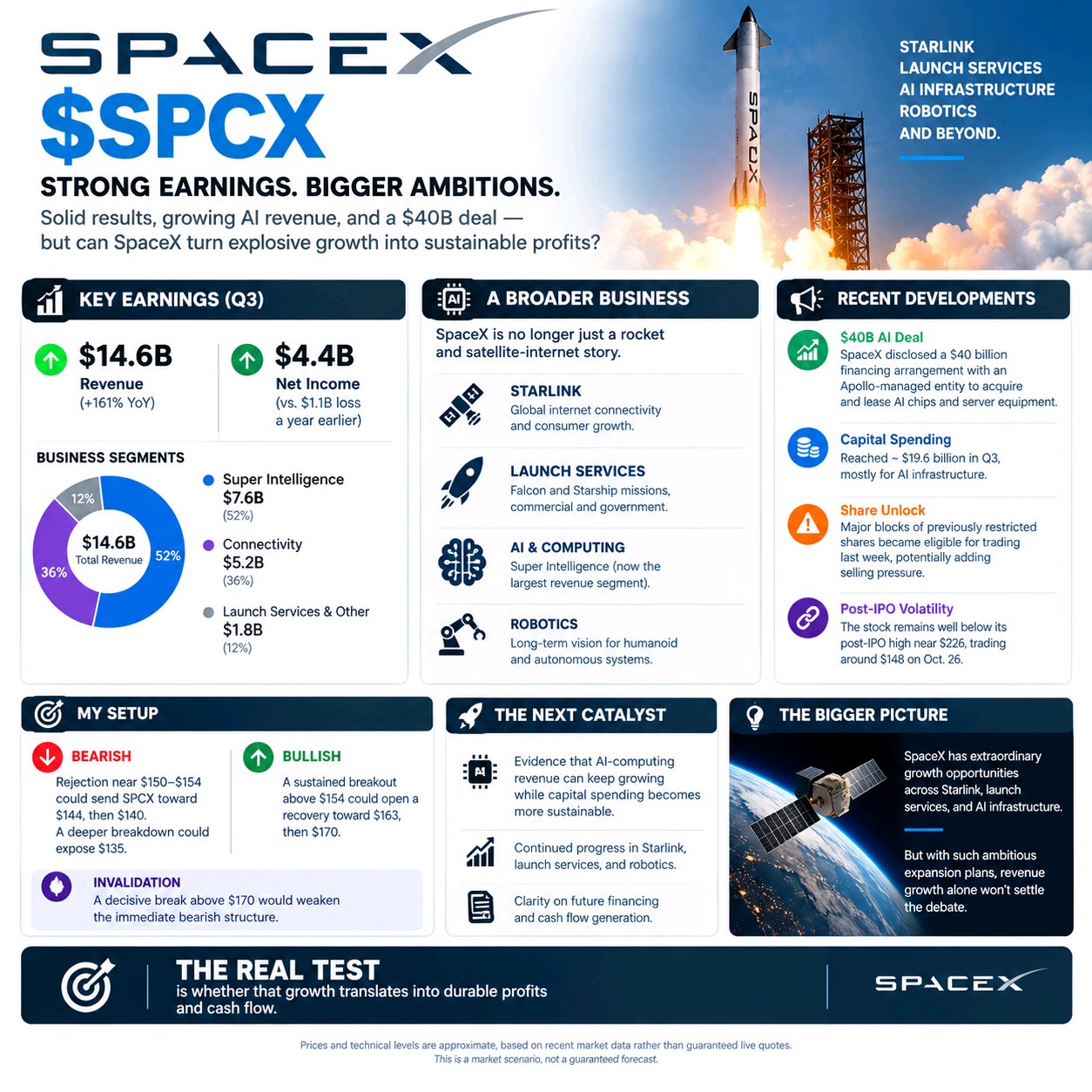
$SPCX is struggling to hold its post-IPO gains. But the interesting part isn't the price drop itself. It's how rapidly SpaceX is changing its business. SpaceX closed around $148 on Monday, October 26, after a volatile week that included a sharp post-earnings selloff. The stock remains well below its post-IPO high near $226. Yet the latest earnings tell a very different story. Q3 revenue reached $14.6 billion, up 161% year over year, while net income came in at $4.4 billion, compared with a $1.1 billion loss a year earlier. The biggest surprise? Its Super Intelligence business generated approximately $7.6 billion in revenue, overtaking connectivity revenue of $5.2 billion. SpaceX is no longer just a rocket and satellite-internet story. AI computing is becoming a major part of the investment thesis. But there's a catch. Capital spending reached roughly $19.6 billion in the quarter, much of it directed toward AI infrastructure. Today, SpaceX also disclosed a $40 billion financing arrangement with an Apollo-managed entity to acquire and lease AI chips and server equipment. That raises an important question: Can SpaceX turn its explosive AI growth into sustainable cash flow without taking on too much financial risk? The stock also faces a supply-side challenge. Major blocks of previously restricted shares became eligible for trading last week, potentially adding selling pressure even after strong earnings. My setup: 📉 Bearish: Rejection around $150–$154 could send SPCX toward $144, followed by $140. A deeper breakdown could expose $135. 📈 Bullish: A sustained breakout above $154 could open a recovery toward $163, then $170. Invalidation: A decisive break above $170 would weaken the immediate bearish structure. The next catalyst: Evidence that AI-computing revenue can keep growing while capital spending becomes more sustainable. SpaceX has extraordinary growth opportunities across Starlink, launch services, and AI infrastructure. But with such ambitious expansion plans, revenue growth alone won't settle the debate. The real test is whether that growth translates into durable profits and cash flow. Prices and technical levels are approximate, based on recent market data rather than live quotes. This is a market scenario, not a guaranteed forecast.$SPCXXUSDT #ByXIMPACT #IMPACTbyTrade #MyByXTake
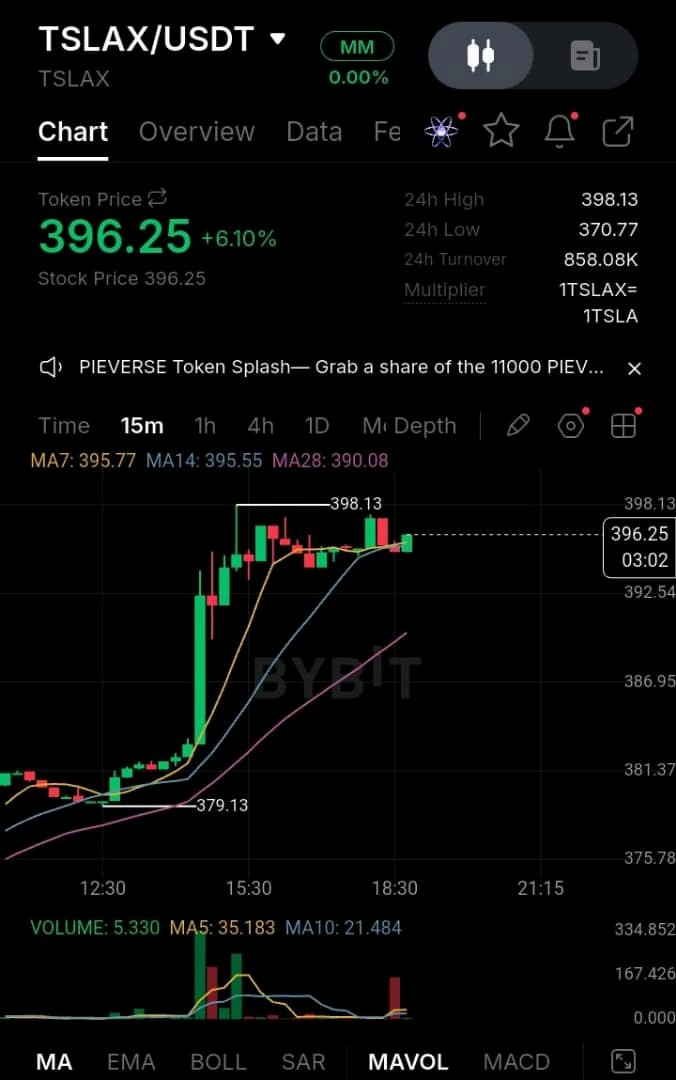
$TSLA is up more than 6% today. But the interesting part isn't the rally itself. It's what the market is starting to price in. Tesla shares surged on Monday after Barclays upgraded the stock to Overweight and raised its price target to $450. Optimism around Robotaxi and a potential Tesla–SpaceX combination is adding fresh momentum. But beneath the rally, the picture is more complicated. Tesla reported Q3 revenue of approximately $28.1 billion, beating expectations. Free cash flow reached $1.5 billion, but net income fell 44% year over year to $787 million. The company also lowered its 2026 capital spending forecast to around $20 billion from more than $25 billion. That raises an important question: is Tesla improving its financial discipline, or are some of its biggest AI and robotics investments being pushed further into the future? The next chapter depends on execution. Cybercab customer deliveries are targeted for year-end, with Dallas Robotaxi expansion planned for November. However, federal scrutiny over Cybercab safety certification remains a significant risk. My setup: 📈 Bullish: Holding above $390 and breaking through $400 could open a move toward $410–$420. 📉 Bearish: Rejection near $400 could bring $390 back into focus, followed by $380–$370 if momentum fades. Invalidation: A sustained breakout above $420 would weaken the immediate bearish scenario. The bigger picture? Tesla is trying to transform from an electric-vehicle maker into an AI, autonomy, and robotics company. The opportunity is enormous, but expectations are already high. The real catalyst isn't another ambitious promise. It's proof that Robotaxi, AI, and robotics can deliver scalable revenue and sustainable profits. Price levels are approximate trading scenarios, not live quotes or guaranteed outcomes.$TSLAXUSDT #ByXIMPACT #MyByXTake #IMPACTbyTrade

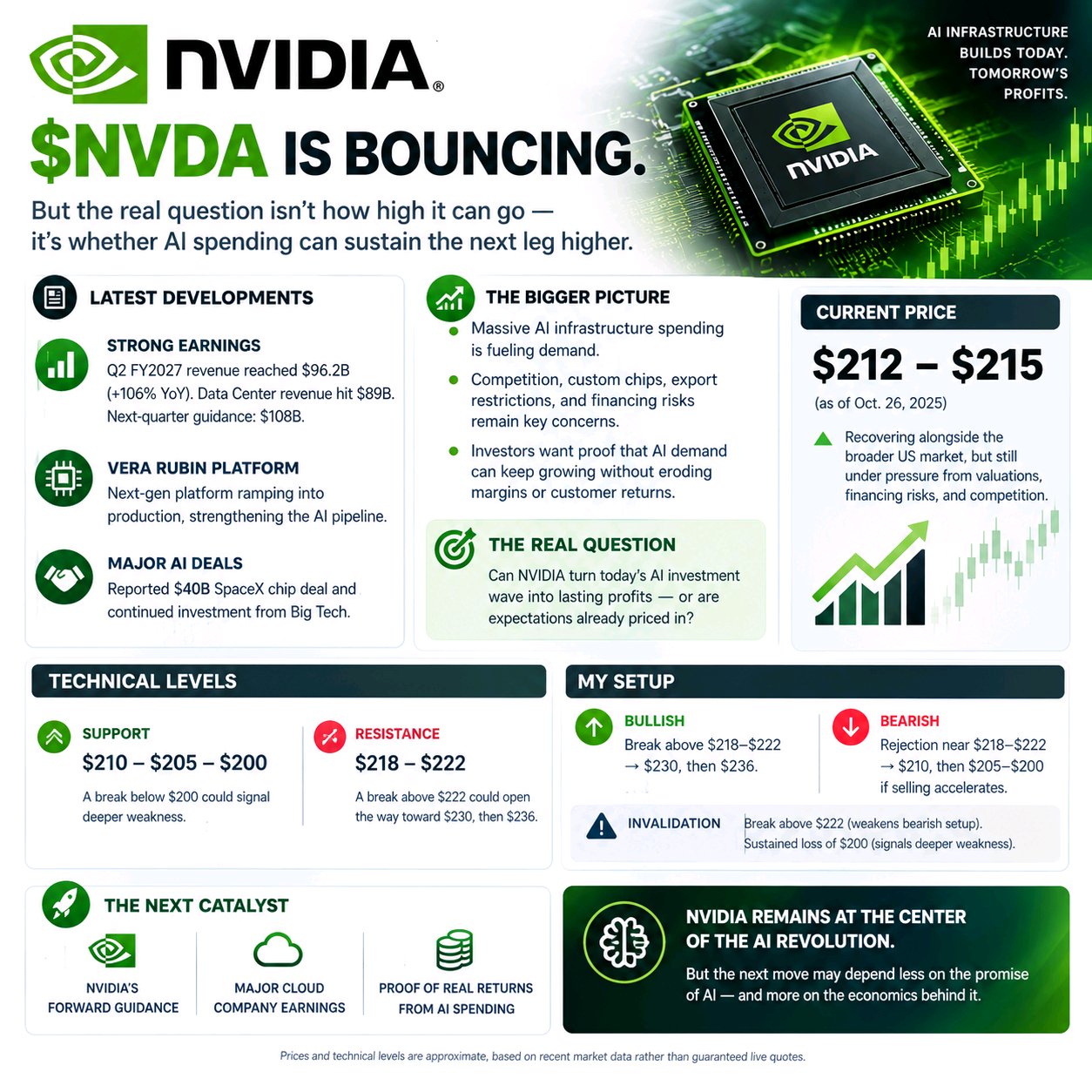
$NVDA is bouncing. But the real question isn't how high it can go — it's whether AI spending can sustain the next leg higher. NVIDIA is trading around $212–$215 as of Monday, October 26, recovering alongside the broader US market. Yet the stock remains under pressure from concerns about AI valuations, financing risks, and whether massive infrastructure spending will translate into lasting profits. The latest developments are creating an interesting picture. NVIDIA's Q2 FY2027 revenue reached $96.2 billion, up 106% year over year, with Data Center revenue hitting $89 billion. Its next-quarter revenue guidance was $108 billion. Those numbers show demand remains powerful. Meanwhile, NVIDIA's next-generation Vera Rubin platform is ramping into production, while new AI infrastructure deals — including a reported $40 billion SpaceX chip deal — reinforce the scale of investment still flowing into the sector. But there's a catch. Big Tech's AI spending is growing so rapidly that investors are asking whether future returns can justify the cost. Custom chips, competition, export restrictions, and financing arrangements remain risks. That changes the short-term equation. Strong earnings alone may no longer be enough. The market wants proof that AI demand can keep growing without margins or customer returns deteriorating. My setup: 📈 Bullish: A sustained break above $218–$222 could open the way toward $230, followed by $236. 📉 Bearish: Rejection near $218–$222 could send NVDA back toward $210, then $205–$200 if selling accelerates. Invalidation: A decisive break above $222 would weaken the immediate bearish setup, while a sustained loss of $200 would signal deeper weakness. The next catalyst: NVIDIA's forward guidance, major cloud companies' earnings, and evidence that AI infrastructure spending is generating real returns. NVIDIA remains at the center of the AI revolution. But the next move may depend less on the promise of AI — and more on the economics behind it. Prices and technical levels are approximate, based on recent market data rather than guaranteed live quotes.$NVDAXUSDT #ByXIMPACT #IMPACTbyTrade #MyByXTake
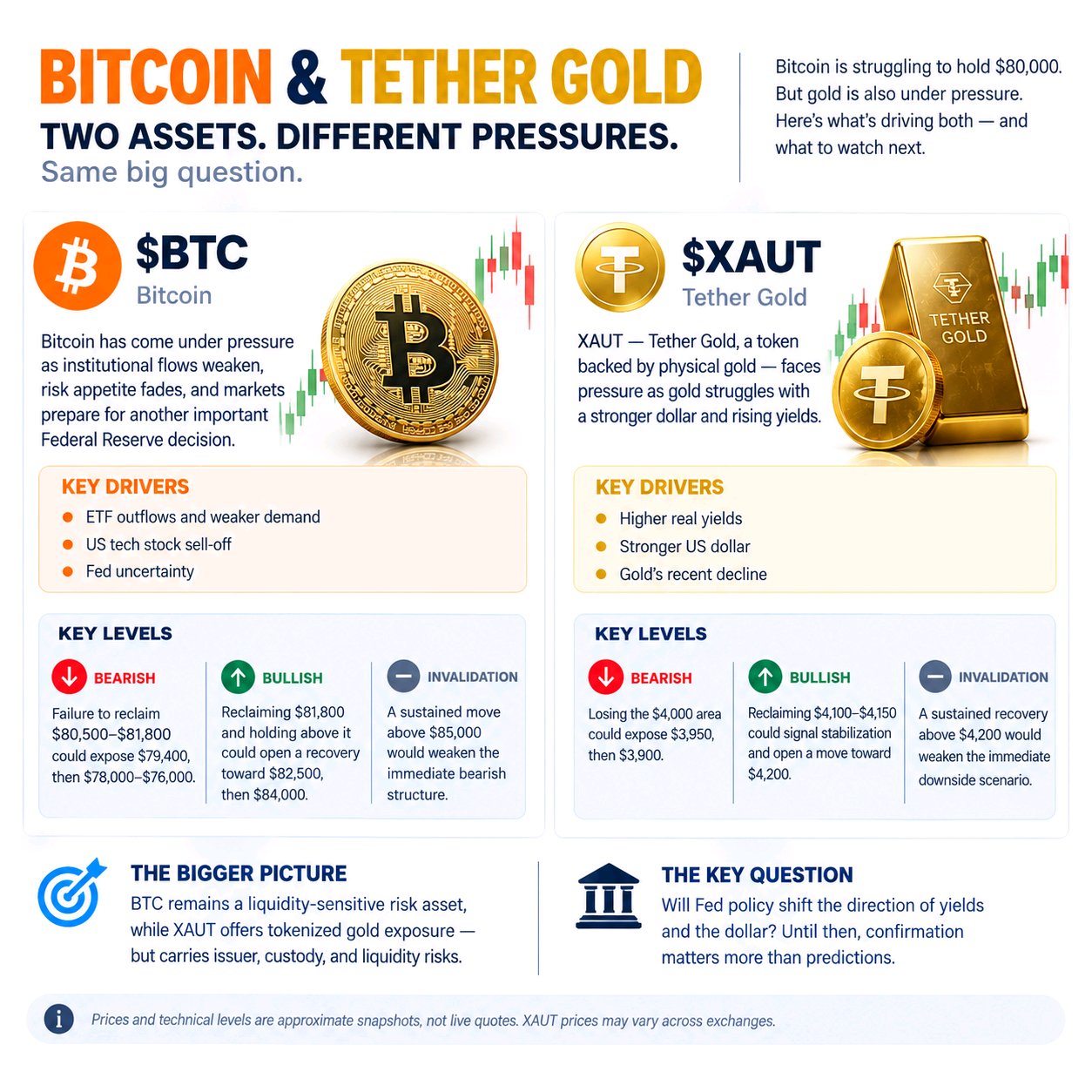
Bitcoin is struggling to hold $80,000. But the interesting part is what’s happening to gold at the same time. $BTC has come under pressure as institutional flows weaken, risk appetite fades, and markets prepare for another important Federal Reserve decision. Meanwhile, $XAUT — Tether Gold, a token backed by physical gold — faces pressure as gold struggles with a stronger dollar and rising yields. That creates an interesting market divergence. Bitcoin is sensitive to liquidity and risk sentiment, while gold faces pressure from interest-rate expectations. Neither asset is completely insulated from macroeconomic uncertainty. My setup: ₿ $BTC Bearish: failure to reclaim $80,500–$81,800 could expose $79,400, followed by $78,000–$76,000. Bullish: reclaiming $81,800 and holding above it could open a recovery toward $82,500, then $84,000. Invalidation: a sustained move above $85,000 would weaken the immediate bearish structure. 🥇 $XAUT Bearish: losing the $4,000 area could expose $3,950, then $3,900. Bullish: reclaiming $4,100–$4,150 could signal stabilization and open a move toward $4,200. Invalidation: a sustained recovery above $4,200 would weaken the immediate downside scenario. The bigger picture: BTC remains a liquidity-sensitive risk asset, while XAUT offers tokenized gold exposure, but carries issuer, custody, and liquidity risks. The next key question is whether Fed policy shifts the direction of yields and the dollar. Until then, confirmation matters more than predictions. Prices and technical levels are approximate snapshots, not live quotes. XAUT prices may vary across exchanges. $BTCUSDT $XAUTUSDT #ByXIMPACT #MyByXTake
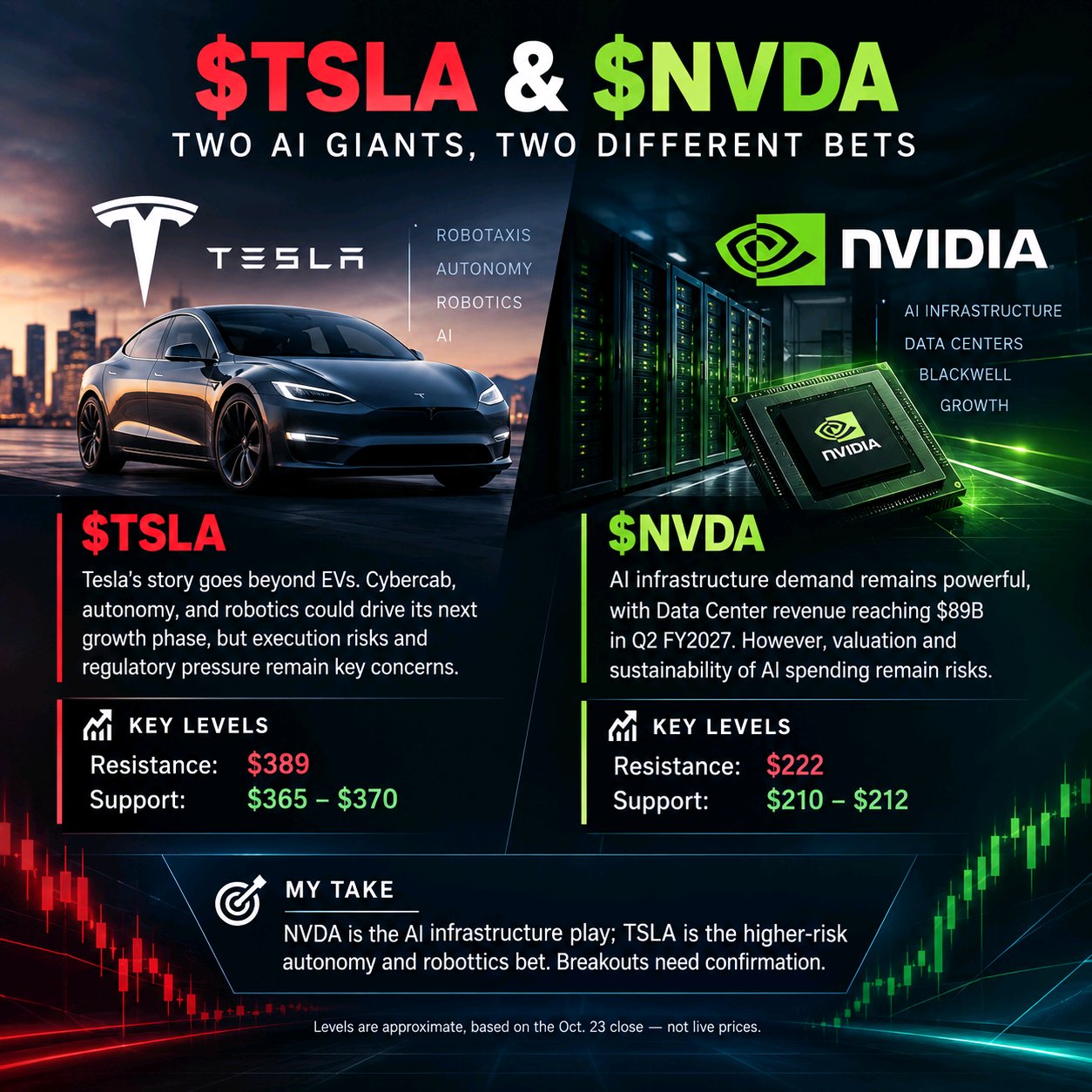
$TSLA & $NVDA — TWO AI GIANTS, TWO DIFFERENT BETS
🚗 $TSLA: Tesla’s story goes beyond EVs. Cybercab, autonomy, and robotics could drive its next growth phase, but execution risks and regulatory pressure remain key concerns. 🖥️ $NVDA: AI infrastructure demand remains powerful, with Data Center revenue reaching $89B in Q2 FY2027. However, valuation and sustainability of AI spending remain risks. 📊 Market focus: - TSLA: Watch resistance near $389 and support around $365–$370. - NVDA: Watch resistance near $222 and support around $210–$212. 🔥 My take: NVDA is the AI infrastructure play; TSLA is the higher-risk autonomy and robotics bet. Breakouts need confirmation. Levels are approximate, based on the Oct. 23 close—not live prices.$TSLAXUSDT $NVDAXUSDT #ByXIMPACT #MyByXTake
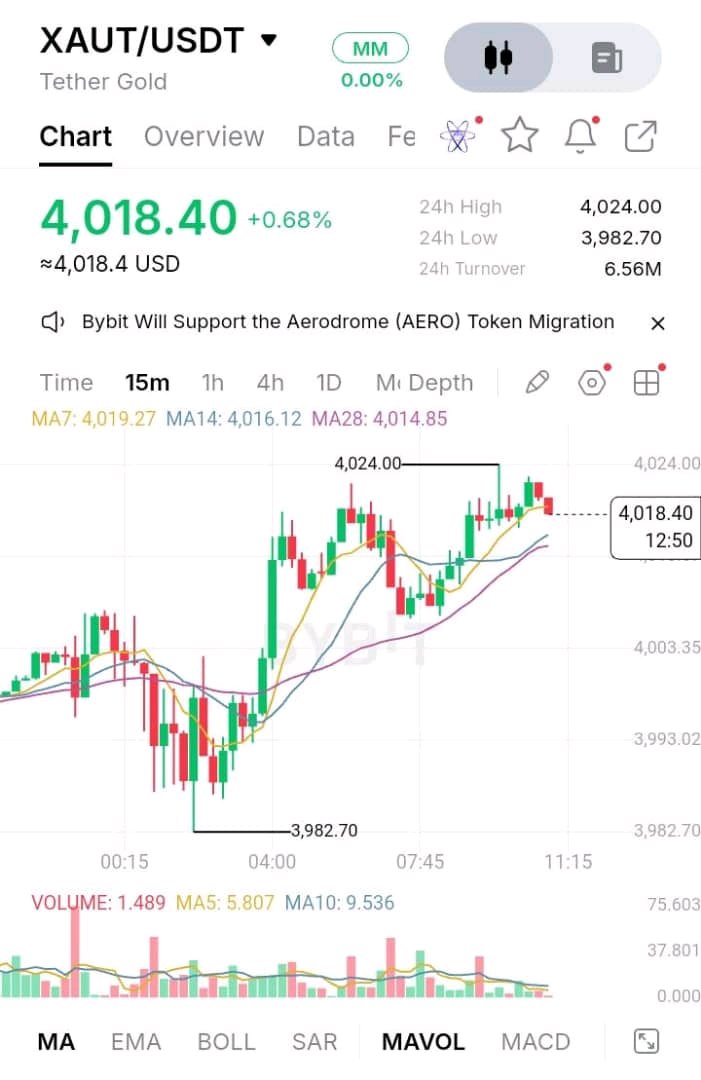
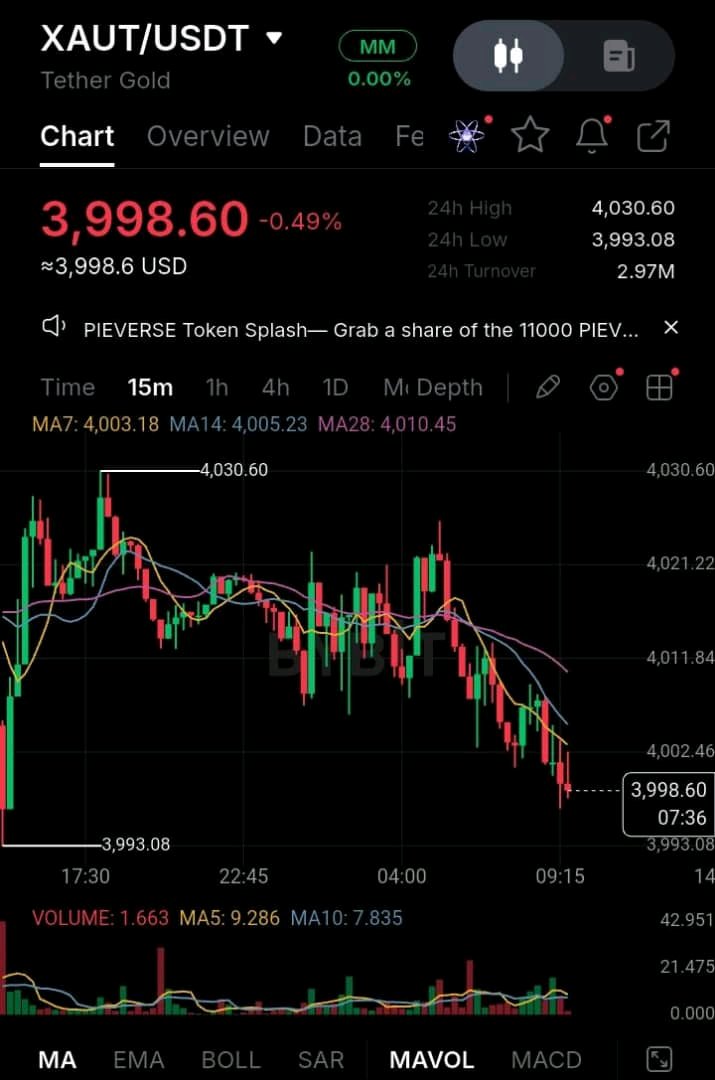
Gold just bounced back above $4,000, but the interesting part isn't the recovery itself. It's whether buyers can turn this rebound into a genuine reversal. XAU/USD recovered toward $4,014 on Monday after Friday's selloff pushed gold as low as $3,975. The recovery comes as oil prices retreat from recent highs, easing some inflation concerns just as markets prepare for the Federal Reserve's October 28 decision. Markets are pricing only a small chance of a hike this week, but expectations for a December increase remain elevated. That changes the short-term gold equation. For weeks, the market has been caught between persistent inflation and expectations for tighter monetary policy. Now, falling oil prices are offering some relief. Lower energy prices could reduce inflation pressure and give the Fed more room to avoid additional tightening. But if oil rebounds and inflation remains sticky, the dollar and Treasury yields could strengthen again, increasing the opportunity cost of holding gold. That's the conflict gold traders need to understand. Safe-haven demand alone may not be enough to drive a sustained rally if monetary policy expectations continue moving against the metal. Technically, $4,030–$4,036 is the first level I'm watching. Gold is attempting to build a base after falling from the $4,140–$4,150 area. The $3,970–$3,985 zone has attracted buyers, but the broader sequence of lower highs remains intact. A failure to reclaim $4,030–$4,036 keeps the short-term structure vulnerable. My setup: Bearish: rejection around $4,030–$4,036 → target $4,000, then $3,975. A decisive breakdown could expose $3,940–$3,955. Bullish: reclaim and hold above $4,036 → potential move toward $4,074, followed by $4,100–$4,110. A sustained break above that second zone would strengthen the recovery case. Invalidation: a sustained recovery above $4,110 would weaken the immediate bearish structure. A break below $3,970 would undermine the developing recovery. But the real catalyst now isn't just another oil-price move. It's the Federal Reserve. The October 28 decision comes first, followed by US PCE inflation data on October 29. If the Fed sounds less hawkish and inflation cools, gold could extend its recovery as yields retreat. If policymakers reinforce expectations for tighter policy, the $4,000 area could come under renewed pressure. Gold isn't necessarily bearish long term. The market is testing whether the recent correction has found a floor or whether monetary policy will force another leg lower. The key isn't predicting the bottom. It's waiting for price to confirm which side is in control. #MyByXTake $XAUTUSDT #ByXIMPACT