William Henry
3383Нравится0Акции389Подписчики885Подписаться
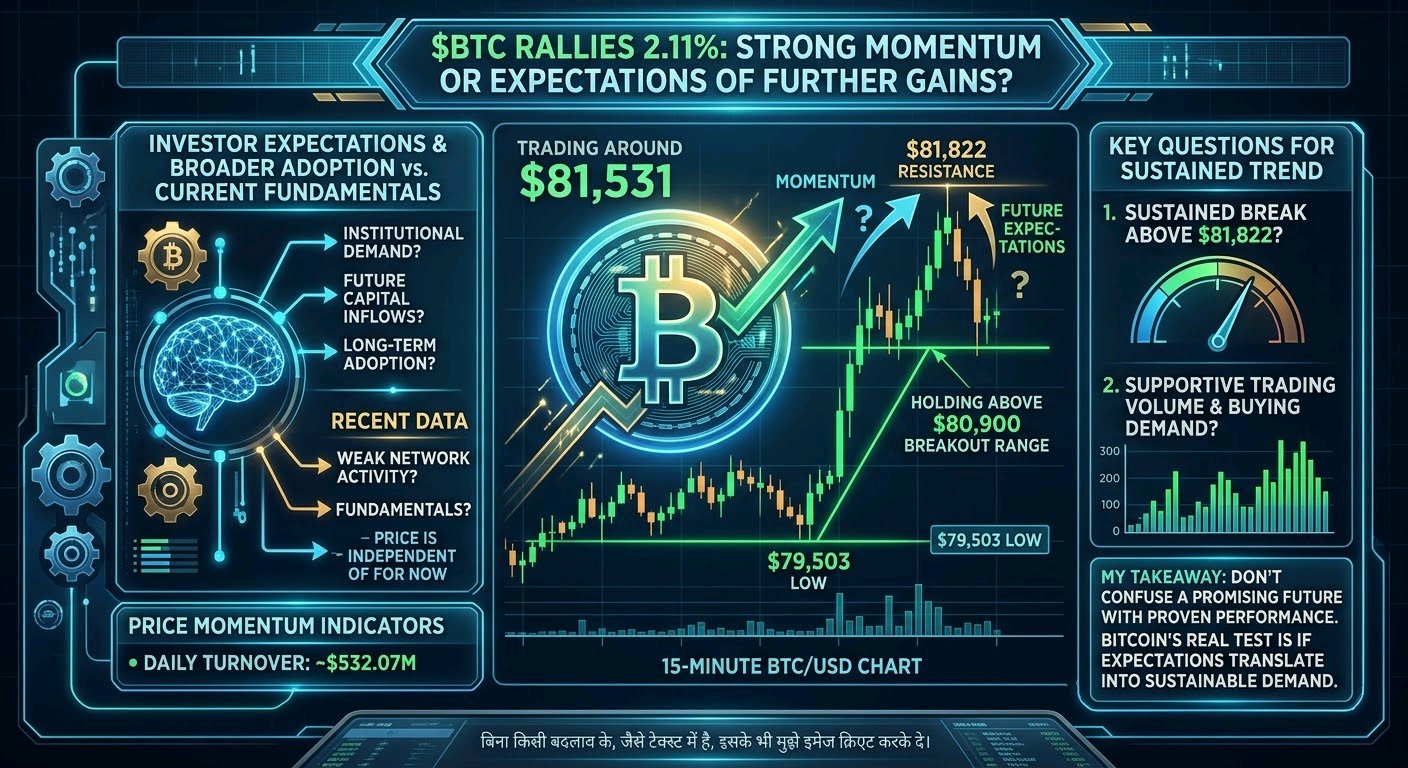
$BTCUSDT Rallies 2.11%: Strong Momentum or Expectations of Further Gains? Let’s discuss something traders often miss: Bitcoin can rally even when its recent network activity or market fundamentals look weak. The key is understanding what investors expect in the future, not just what the latest data shows. BTC is trading around $81,531 after climbing from the intraday low of $79,503. The 15-minute chart shows a sharp upward move, suggesting buyers have stepped in with conviction. However, the chart alone cannot confirm what is driving the rally, and speculation about institutional demand or future capital inflows should not be mistaken for confirmed catalysts. Looking at the price action, Bitcoin has gained 2.11% in 24 hours, while its daily turnover stands at approximately $532.07 million on the displayed market feed. The recent surge also faced resistance near $81,822, followed by a pullback. The positive side is that BTC is holding above its earlier trading range near $80,900, suggesting the breakout has not immediately reversed. This highlights an important distinction: price momentum reflects current market demand, while network activity and capital flows help explain broader adoption. These signals can move in different directions. One strong move does not guarantee a sustained trend. Traders should avoid drawing conclusions from a single 15-minute chart. So what matters next? 1. Whether BTC breaks above $81,822 and sustains that level. 2. Whether trading volume and buying demand support another leg higher. My takeaway: don’t confuse a promising future with proven performance. Bitcoin’s real test is whether today’s expectations translate into sustainable demand and long-term adoption. #ByXIMPACT
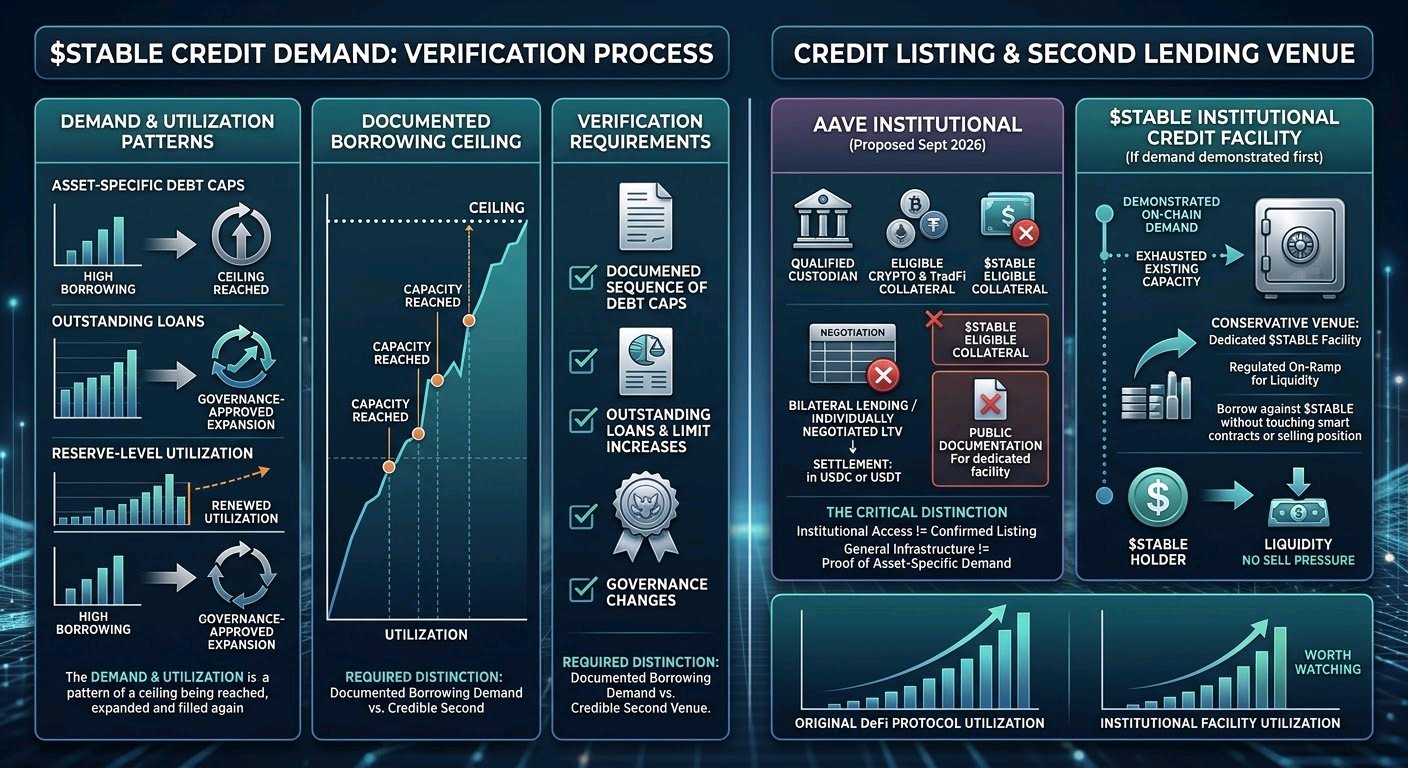
$STABLEUSDT requires a distinction between documented borrowing demand and the existence of a credible second lending venue. Repeatedly exhausting a collateral-backed credit ceiling on a protocol such as Aave would indicate that borrowers are willing to use their holdings to access liquidity rather than sell their positions, but that conclusion requires verified reserve-level utilization, debt balances and governance changes. The important signal is not simply high borrowing; it is the pattern of a ceiling being reached, expanded and filled again, demonstrating that available credit may be lagging demand. For $STABLE, the critical evidence would be a documented borrowing ceiling repeatedly reaching capacity, followed by governance-approved expansions and renewed utilization. I could not verify an asset-specific sequence of debt caps, outstanding loans and limit increases that would justify assigning figures such as $24.99M against a $25M ceiling. Aave Institutional, proposed in September 2026, offers a relevant comparison: bilateral lending against eligible crypto and traditional-finance collateral held with qualified custodians, with settlement in USDC or USDT and individually negotiated loan-to-value ratios. However, public documentation does not establish that $STABLE itself is eligible collateral or disclose a dedicated facility for its holders. That distinction matters: institutional credit access is not equivalent to a confirmed listing, and general lending infrastructure is not proof of asset-specific demand. If a lender opens a dedicated $STABLE facility after on-chain borrowing repeatedly exhausts existing capacity, the sequence would be notable. The demand would have been demonstrated first, with the more conservative venue arriving afterward to absorb potential overflow. It would be less a spot listing and more a credit listing — a regulated on-ramp for holders seeking liquidity against $STABLE without touching a smart contract or selling the underlying position. The thesis depends on verified collateral eligibility, published terms and observable utilization rather than an assumed institutional connection. Worth watching whether utilization on a verified $STABLE credit facility fills anywhere near as fast as the original DeFi protocol’s did. #ByXIMPACT
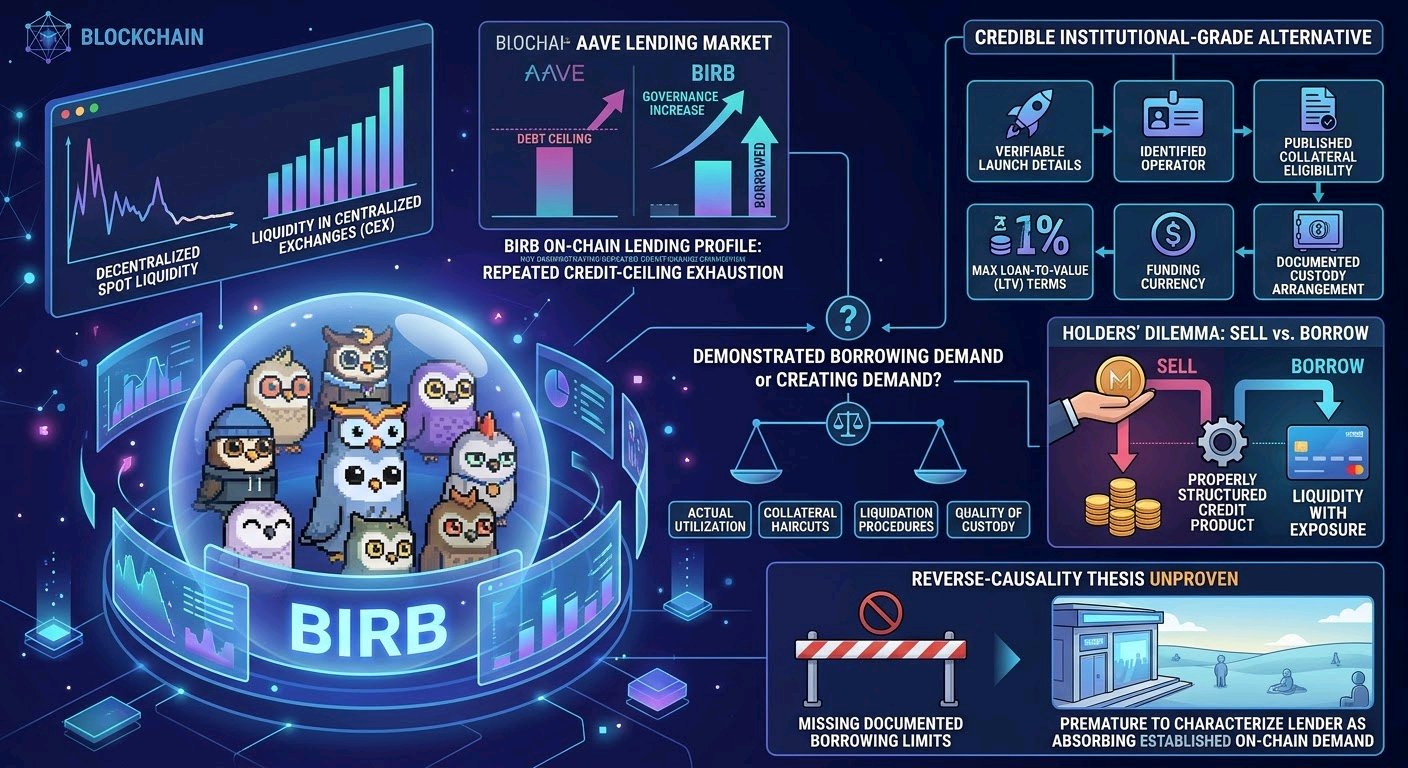
$BIRBUSDT ’s on-chain lending profile does not currently establish the kind of repeated credit-ceiling exhaustion that would support a direct comparison with Aave. Available market data identifies BIRB as the Moonbirds token, with liquidity concentrated primarily in centralized exchanges and comparatively limited decentralized spot liquidity. No verified record establishes an Aave isolated debt ceiling being repeatedly filled, followed by governance increases that borrowers subsequently exhausted. That distinction matters when assessing whether a second lending venue represents a response to demonstrated borrowing demand or an attempt to create demand through new infrastructure. A credible institutional-grade alternative would need verifiable launch details, an identified operator, published collateral eligibility, maximum loan-to-value terms, funding currency, and a documented custody arrangement. No independently verified BIRB-backed credit facility with those specifications is established by the available evidence. The broader market structure nevertheless presents a relevant question: whether holders of a relatively thinly traded token would value borrowing against their positions more than selling them outright. A properly structured credit product could offer liquidity while preserving exposure to the underlying asset, but its significance would depend on actual utilization, collateral haircuts, liquidation procedures, and the quality of custody rather than the venue’s institutional positioning alone. The reverse-causality thesis therefore remains unproven for BIRB: without documented borrowing limits repeatedly being reached before a new lender’s arrival, it would be premature to characterize that lender as absorbing established on-chain demand. Worth watching whether utilization on any verified BIRB-backed lending venue fills anywhere near as fast as a documented original DeFi protocol’s did. #ByXIMPACT
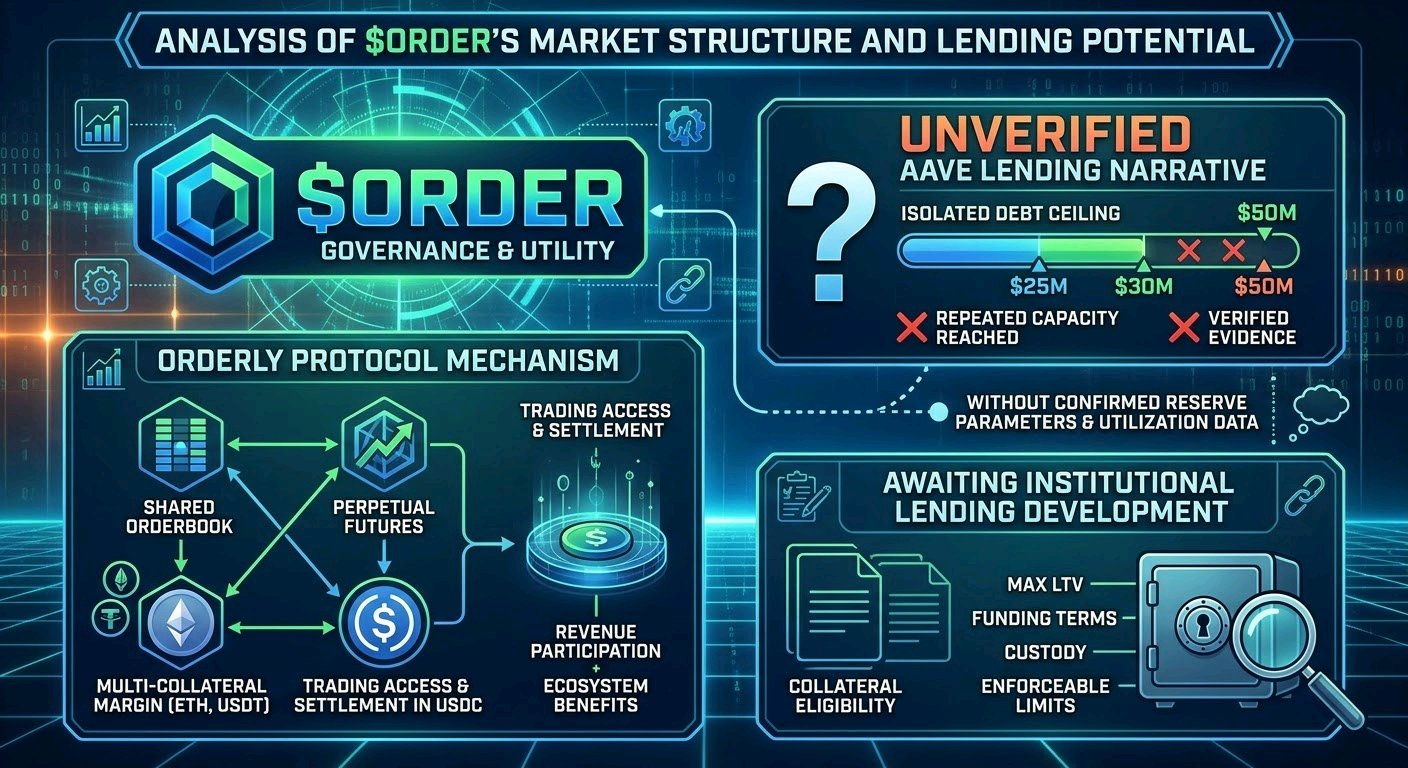
$ORDERUSDT ’s current market structure does not yet establish the borrowing pattern that would support a conventional credit-expansion thesis. There is no verified evidence available here of an Aave isolated debt ceiling repeatedly reaching capacity against successive governance increases, whether from $25M to $30M, $30M to $50M, or beyond. Without confirmed reserve parameters and historical utilization data, treating that sequence as documented demand would overstate what the on-chain record supports. The more clearly established mechanism sits within Orderly itself. The protocol operates shared orderbook infrastructure for perpetual futures, while $ORDER functions as its governance and utility token, with staking tied to protocol revenue participation and ecosystem benefits. Orderly has also introduced multi-collateral margin, allowing assets such as ETH and USDT to support trading positions settled in USDC. That is a meaningful distinction between trading access and secured lending: collateral can support market exposure without requiring an outright sale, but it does not establish that holders can borrow USD against $ORDER through a regulated credit facility. A separate institutional lending venue would therefore represent a material development, particularly if it disclosed collateral eligibility, maximum LTV, funding terms, custody arrangements and enforceable lending limits. No verified launch details currently establish such a facility for $ORDER, and assigning a lender, launch date or credit ceiling without documentation would create a false signal of institutional adoption. The relevant question is whether measurable borrowing demand emerges before dedicated credit infrastructure is introduced, rather than whether an unverified lending narrative can be constructed around the token. #ByXIMPACT
$XAUTUSDT sits at an interesting intersection between tokenized gold and collateral-backed credit, but the key question is whether borrowing demand against Tether Gold is strong enough to repeatedly exhaust available lending capacity. A utilization pattern near an isolated debt ceiling, followed by successive governance increases and renewed borrowing, would provide evidence that demand is outrunning available credit rather than reflecting a one-off liquidity event. The pattern became explicit on Aave: by January 29, 2026, XAUT-backed borrowing had reached $24.99 million against a $25 million isolated debt ceiling. Governance subsequently raised the limit repeatedly, yet borrowers continued absorbing the additional capacity, indicating persistent demand for liquidity against tokenized gold. On September 1, 2026, Arch Lending, operated by ChainFi, Inc., introduced a more conservative alternative by accepting both XAUT and PAXG as collateral. Eligible borrowers can access USD or USDC funding at initial loan-to-value ratios of up to 75%, generally through 12-month loans. Collateral is held by Anchorage Digital Bank, a federally chartered national trust bank, with no rehypothecation. This is less a spot listing and more a credit listing — a regulated on-ramp for holders who want liquidity against XAUT without touching a smart contract or selling the underlying position. The distinction is structural: Aave provides permissionless, on-chain borrowing, while Arch introduces custodial infrastructure, defined loan terms and institutional lending controls. The sequence matters. Typically, a new lending venue is launched speculatively and waits for borrowers to arrive. Here, demand was already documented on-chain, with Aave’s debt ceiling repeatedly becoming a constraint before Arch expanded access through a different credit model. The question is whether that established borrowing appetite translates into sustained utilization outside DeFi. Worth watching whether utilization on Arch Lending’s book fills anywhere near as fast as Aave’s did. #ByXIMPACT
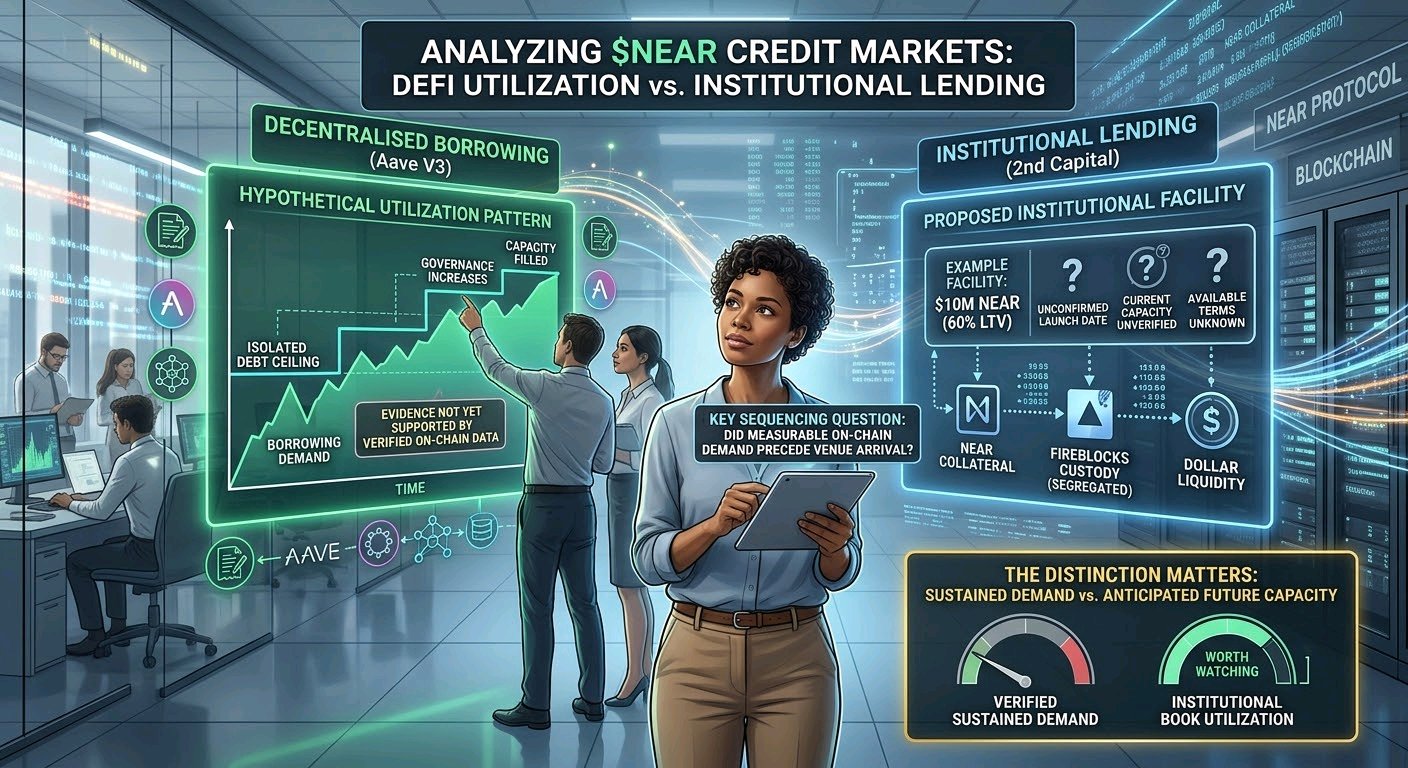
$NEARUSDT presents an interesting credit-market question, but the evidence does not yet support a verified pattern of borrowers repeatedly exhausting an isolated debt ceiling on Aave, with governance raising the limit only for the new capacity to fill again. That distinction matters: sustained borrowing demand is a stronger signal than a single increase in utilization, and the figures need to be confirmed against on-chain market data. The institutional lending angle is worth examining separately. 2nd Capital advertises digital-asset-backed financing, including a published example of a $10 million NEAR facility at 60% loan-to-value, with Fireblocks identified for segregated custody. However, that example does not establish a newly opened NEAR lending book, a confirmed launch date, or current available capacity. The distinction is less a spot listing and more a credit listing: a potential route for holders to access dollar liquidity against $NEAR without selling their underlying position. Yet the actual terms, funding currency, collateral eligibility, custody structure, and facility availability must be verified before treating it as a live alternative to decentralized borrowing. The important sequencing question is whether measurable on-chain borrowing demand preceded the arrival of a more conservative lending venue, rather than the venue simply anticipating future demand. Worth watching whether utilization on a verified institutional $NEAR lending book fills anywhere near as fast as the relevant DeFi market's did. #ByXIMPACT
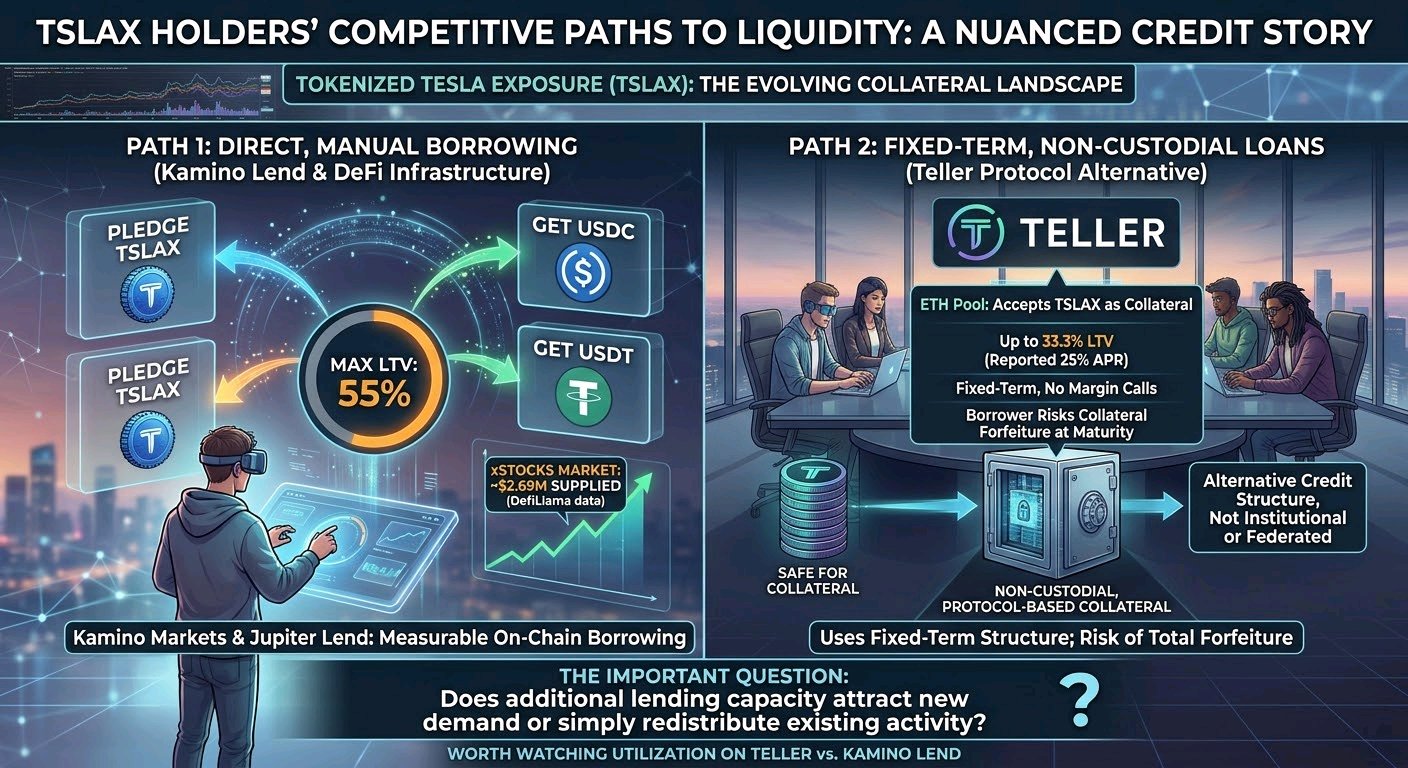
$TSLAXUSDT already has a measurable on-chain borrowing market, but the available data points to a more nuanced credit story than a simple lending-capacity shortage. DefiLlama tracks approximately $2.69M supplied to the xStocks Market on Kamino Lend, alongside borrowing routes through Kamino and Jupiter Lend. Reported maximum LTVs reach 55% on Kamino markets and 65% on Jupiter Lend, with USDC among the available borrowing assets. A second lending route exists through Teller, where its Ethereum pool accepts TSLAx as collateral for USDC loans at up to 33.3% LTV and a reported 25% APR. The product uses fixed-term loans without ongoing margin calls, although borrowers face the risk of forfeiting collateral if they fail to repay at maturity. The distinction matters. Teller provides an alternative credit structure, but its documented terms do not establish a federally regulated banking arrangement, and its lending model should not be presented as equivalent to a regulated institutional credit facility. Likewise, the available evidence does not establish that TSLAx repeatedly exhausted an Aave debt ceiling before Teller's market became available. The broader signal is that tokenized Tesla exposure is becoming usable collateral across multiple lending venues, allowing holders to access liquidity without necessarily selling their underlying position. The next question is whether additional lending capacity attracts sustained borrowing demand or simply distributes existing activity across competing markets. Worth watching whether utilization on Teller's book fills anywhere near as fast as Kamino Lend's did. #ByXIMPACT
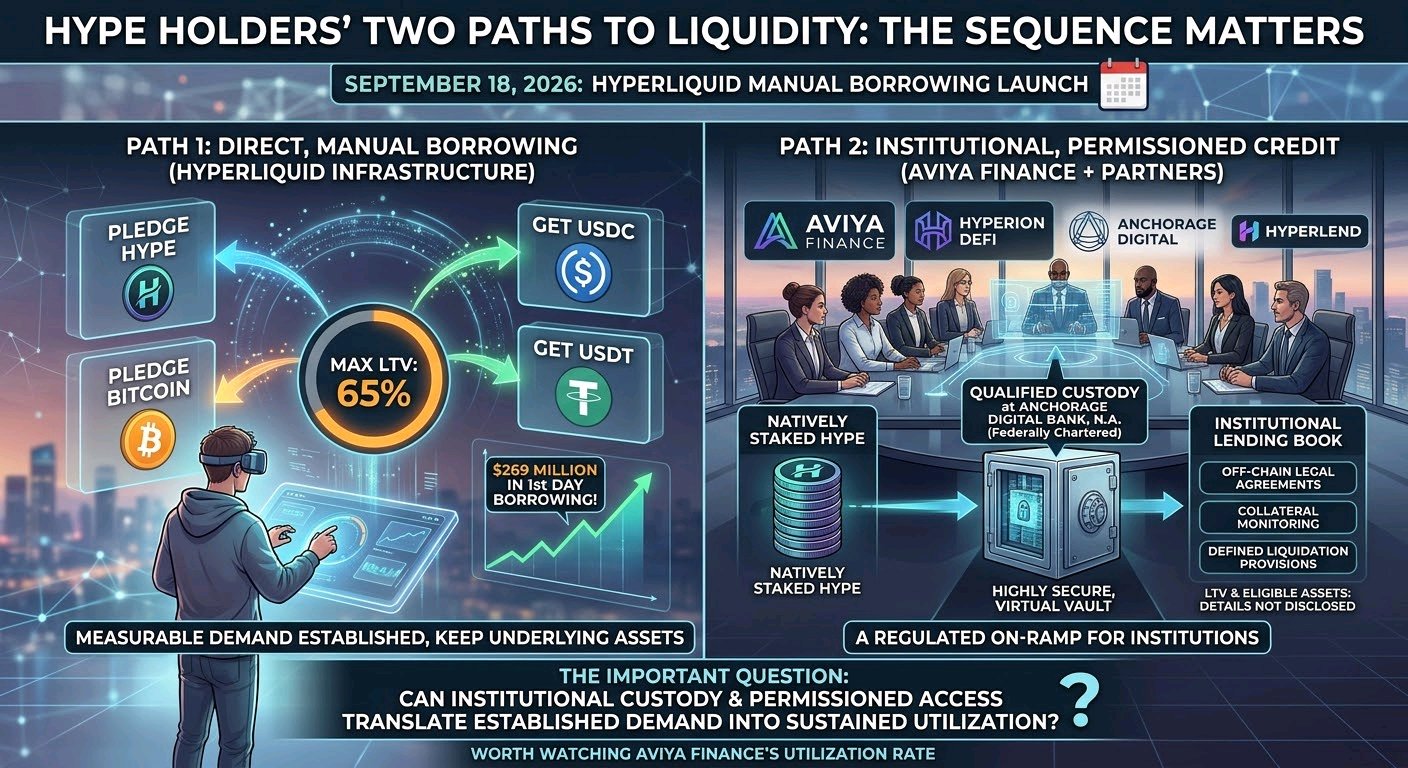
$HYPEUSDT holders now have two distinct routes to liquidity against their positions, but the sequence matters. Hyperliquid introduced manual borrowing on September 18, 2026, allowing users to pledge HYPE or Bitcoin for USDC or USDT, with HYPE carrying a 65% maximum loan-to-value ratio. The launch reportedly generated $269 million in borrowing on its first day, establishing measurable demand for collateral-backed liquidity without requiring holders to sell their underlying assets. The institutional alternative arrived on September 30, when Hyperion DeFi, Anchorage Digital and HyperLend announced Aviya Finance, a permissioned credit venue built around institutional lending on HyperEVM. Its initial facility uses natively staked HYPE as collateral, held in qualified custody at Anchorage Digital Bank, N.A., a federally chartered digital-asset bank. The structure combines on-chain lending infrastructure with off-chain legal agreements, collateral monitoring and defined liquidation provisions; the announcement did not disclose a specific maximum LTV or a complete list of additional eligible assets. The distinction is less a spot listing and more a credit listing — a regulated on-ramp for institutions seeking liquidity against HYPE without surrendering qualified custody of the underlying position. Rather than launching a credit product and waiting for demand to materialize, the venue enters a market where borrowing activity has already been demonstrated through Hyperliquid's own infrastructure. The important question is whether institutional custody and permissioned access can translate that established demand into sustained utilization. Worth watching whether utilization on Aviya Finance's book fills anywhere near as fast as Hyperliquid's did. #ByXIMPACT
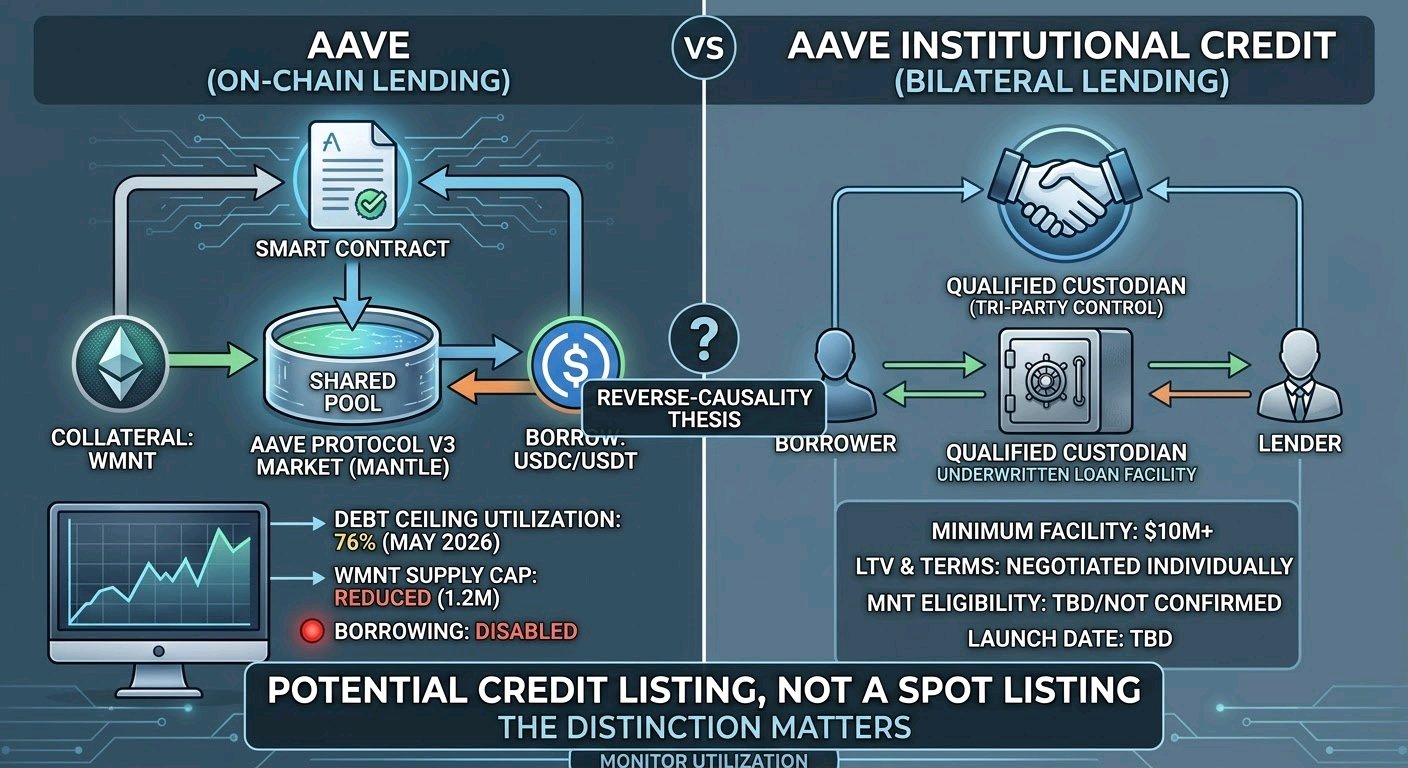
$MNTUSDT ’s credit story is developing across two distinct lending models, but the on-chain evidence does not yet establish a repeated pattern of borrowers exhausting a fixed debt ceiling. Aave’s Mantle deployment lists WMNT as collateral, with an initial 40% loan-to-value ratio and a $2 million isolated debt ceiling in its January 2026 risk specifications. Subsequent risk changes have materially altered the framework: by May 2026, Aave’s risk stewards reported WMNT supply-cap utilization at 76%, with the recommended cap reduced from 1.9 million to 1.226 million tokens and borrowing disabled. That is a meaningful signal of active risk management, not proof of successive credit ceilings being raised and immediately exhausted. The more conservative alternative is Aave Institutional Credit, a custody-first lending service publicly presented by Aave for institutional counterparties. Loans are bilaterally underwritten, settled in USDC or USDT, and backed by collateral held with a qualified custodian under tri-party control. The stated minimum facility is $10 million, with loan terms and LTV determined individually rather than through a common lending pool. However, public materials do not establish that MNT is currently eligible collateral, disclose a fixed MNT-specific LTV, or identify a confirmed launch date for an MNT-backed facility. The distinction matters. This is less a spot listing and more a potential credit listing: a regulated-custody route to liquidity without requiring holders to sell their underlying position or deposit collateral into a lending smart contract. Yet the reverse-causality thesis remains unproven for MNT; documented on-chain utilization alone does not establish that a second venue was launched to absorb unmet demand. Worth watching whether utilization on Aave Institutional Credit’s book fills anywhere near as fast as Aave’s did. #ByXIMPACT
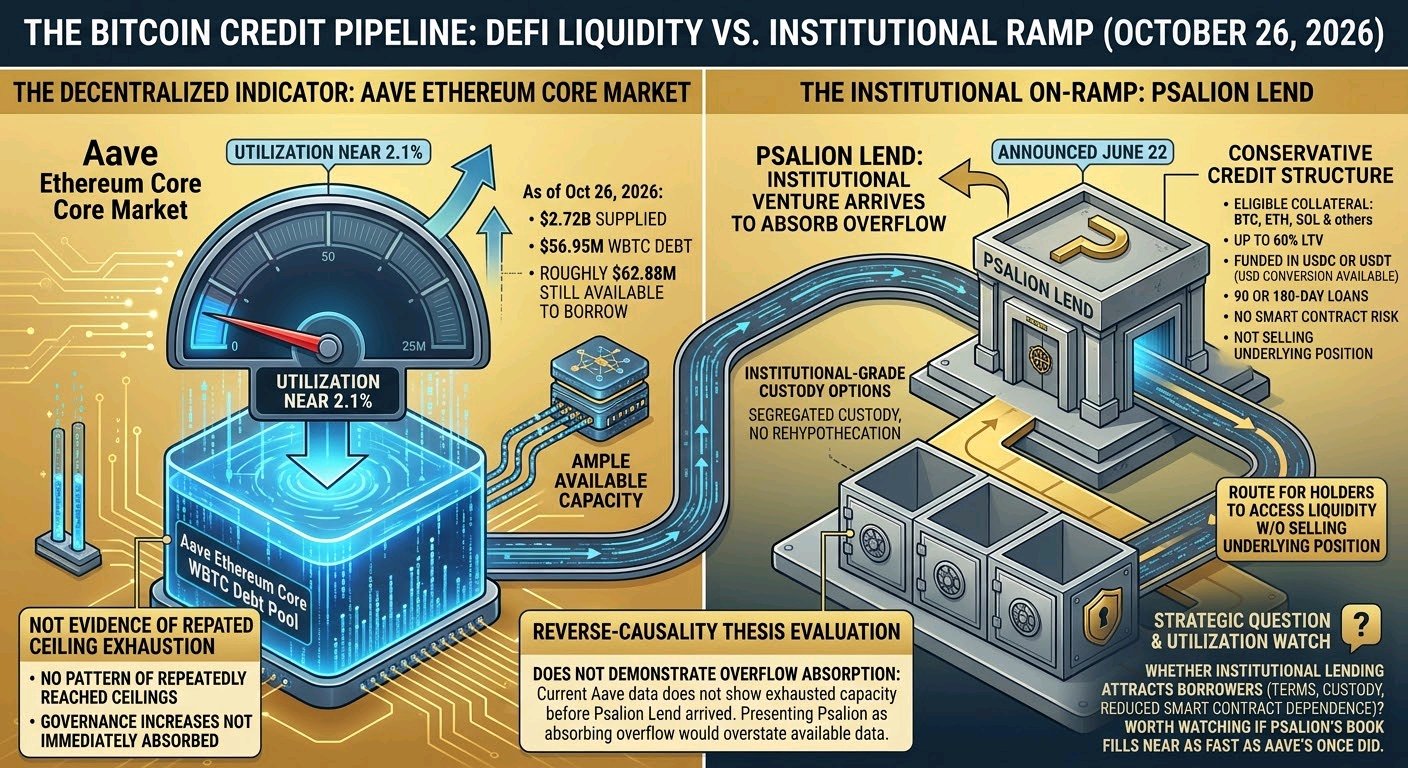
$BTCUSDT ’s on-chain credit data does not currently support the familiar pattern of borrowers repeatedly exhausting Aave’s lending capacity. As of October 26, 2026, Aave’s Ethereum Core market held approximately $56.95 million in WBTC debt against $2.72 billion supplied, with utilization near 2.1% and roughly $62.88 million still available to borrow. That is meaningful lending activity, but not evidence of a credit ceiling repeatedly being reached or governance increases being immediately absorbed. A different development arrived on June 22, when Psalion launched Psalion Lend, an institutional digital-asset-backed lending service supporting BTC, ETH, SOL and other eligible assets. Operated by Psalion, the service offers loans of up to 60% loan-to-value, funded in USDC or USDT, with USD conversion available on request. Its published structure includes segregated institutional-grade custody options, no rehypothecation and loan terms of 90 or 180 days. The announcement does not establish a federally chartered bank custody arrangement or demonstrate that the product is a regulated substitute for Aave. The distinction is less a spot listing and more a credit listing — a route for Bitcoin holders to access liquidity without selling their underlying position. The strategic question is whether institutional lending can attract borrowers who prioritize defined terms, custody transparency and reduced dependence on smart contracts. The reverse-causality thesis, however, requires evidence that DeFi credit capacity was exhausted before the alternative arrived. Current Aave utilization does not establish that sequence, so presenting Psalion as absorbing overflow would overstate the available data. Worth watching whether utilization on Psalion’s book fills anywhere near as fast as Aave’s did. #ByXIMPACT
$BTCUSDT institutional credit thesis needs to be separated from what the available on-chain data actually establishes. Aave’s January 29, 2026 risk review reported that WBTC borrowing demand on Ethereum Core had declined substantially, with borrow-cap utilization at approximately 5% and aggregate borrowing down roughly 70% from its all-time high. Rather than repeatedly exhausting available credit, the market was operating well below its configured borrowing limit. That distinction matters when evaluating the next phase of Bitcoin-backed lending. A regulated lender offering dollar liquidity against BTC could appeal to holders who want to preserve their underlying exposure, but the existence of that opportunity does not establish that a new venue has launched or that demand has already exceeded available capacity. The relevant comparison is therefore not simply DeFi versus institutional finance. It is demonstrable utilization versus prospective demand. On-chain lending provides observable evidence of borrowing activity, while a centralized credit facility would need to establish its own collateral eligibility, maximum loan-to-value ratio, funding currency, custody arrangements and utilization history before the two models could be meaningfully compared. The strongest version of this thesis would require verified evidence of a new BTC-backed lending venue, its launch date and operating terms, alongside historical utilization data showing whether borrowers repeatedly exhausted existing capacity before its arrival. Worth watching whether utilization on a verified new venue’s book fills anywhere near as fast as the original DeFi protocol’s did. #ByXIMPACT

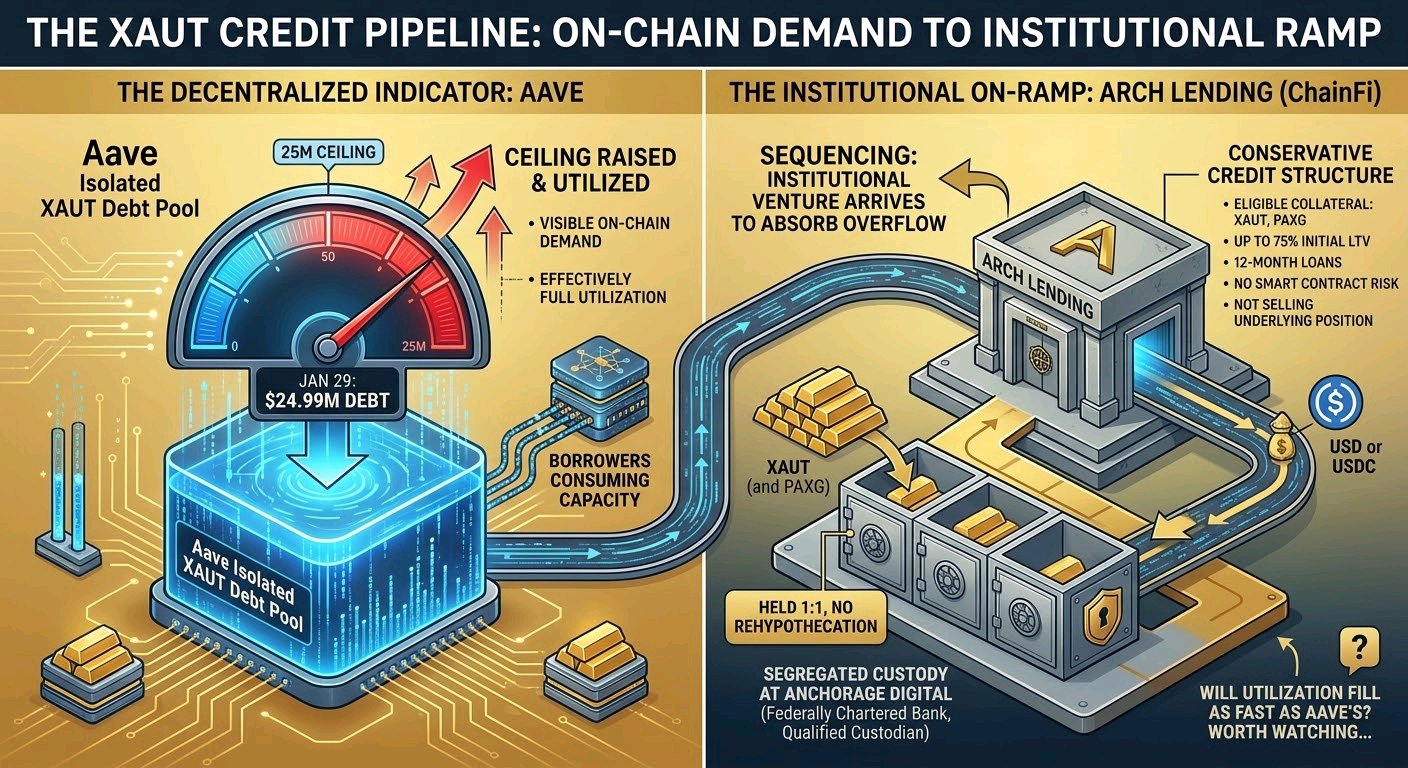
$XAUTUSDT demand for credit has already been visible on Aave: by January 29, outstanding isolated debt reached $24.99M against a $25M ceiling — effectively full utilization — and the ceiling was subsequently raised as borrowers continued consuming the available capacity. On September 1, Arch Lending, operated by ChainFi, opened the same trade in a more conservative structure, accepting XAUT alongside PAXG at up to 75% initial LTV. Loans are generally 12 months, funded in USD or USDC, with eligible collateral held 1:1 in segregated custody at Anchorage Digital, a federally chartered bank and qualified custodian, with no rehypothecation. That makes this less a spot listing and more a credit listing — a regulated on-ramp for holders who want liquidity against XAUT without touching a smart contract or selling the underlying position. The interesting part is the sequencing. Usually, a new lending venue is built speculatively and then waits for borrowers to arrive. Here, the demand was already documented on-chain: Aave’s isolated XAUT market repeatedly ran into its risk ceiling before a second, more institutional venue arrived to absorb potential overflow. The distinction is meaningful because the product is not merely adding another place to trade gold; it is expanding the ways tokenized gold can function as productive collateral. Worth watching whether utilization on Arch Lending’s book fills anywhere near as fast as Aave’s did. #ByXIMPACT

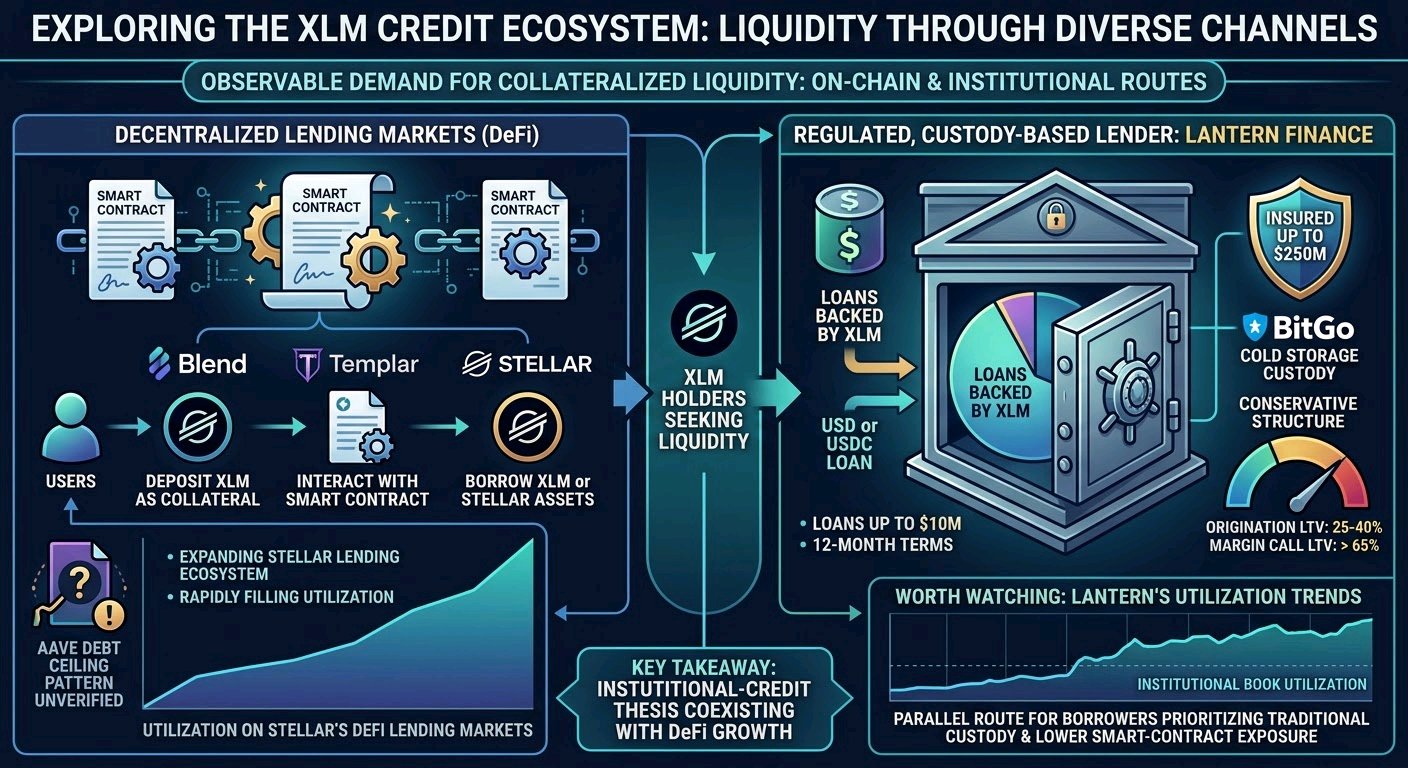
$XLMUSDT holders are already using credit markets for liquidity, but the on-chain record does not support the specific Aave-style $25M→$50M debt-ceiling pattern. Aave’s current isolation framework uses governance-set debt ceilings, yet I could not verify an XLM isolated market or repeated ceiling increases. The more concrete second venue is Lantern Finance, which has added XLM-backed borrowing for USD or USDC, with loans up to $10M, 12-month terms and collateral held through BitGo cold storage, insured up to $250M. Its stated structure is deliberately conservative: loans are typically originated around 25–40% LTV, with a margin call above 65% LTV. That makes the development less a spot listing and more a credit listing — a regulated on-ramp for holders who want liquidity against XLM without touching a smart contract or selling the underlying position. The interesting part is that the institutional-credit thesis is appearing alongside an expanding Stellar lending ecosystem, where Blend and newer protocols such as Templar already support borrowing against XLM or other Stellar collateral. The reverse-causality framing is therefore more nuanced than an Aave ceiling story: XLM already has observable demand for collateralized liquidity, while a more conservative custody-based lender is building a parallel route for borrowers who prioritize traditional custody and lower smart-contract exposure. Worth watching whether utilization on Lantern’s book fills anywhere near as fast as Stellar’s DeFi lending markets did. #ByXIMPACT
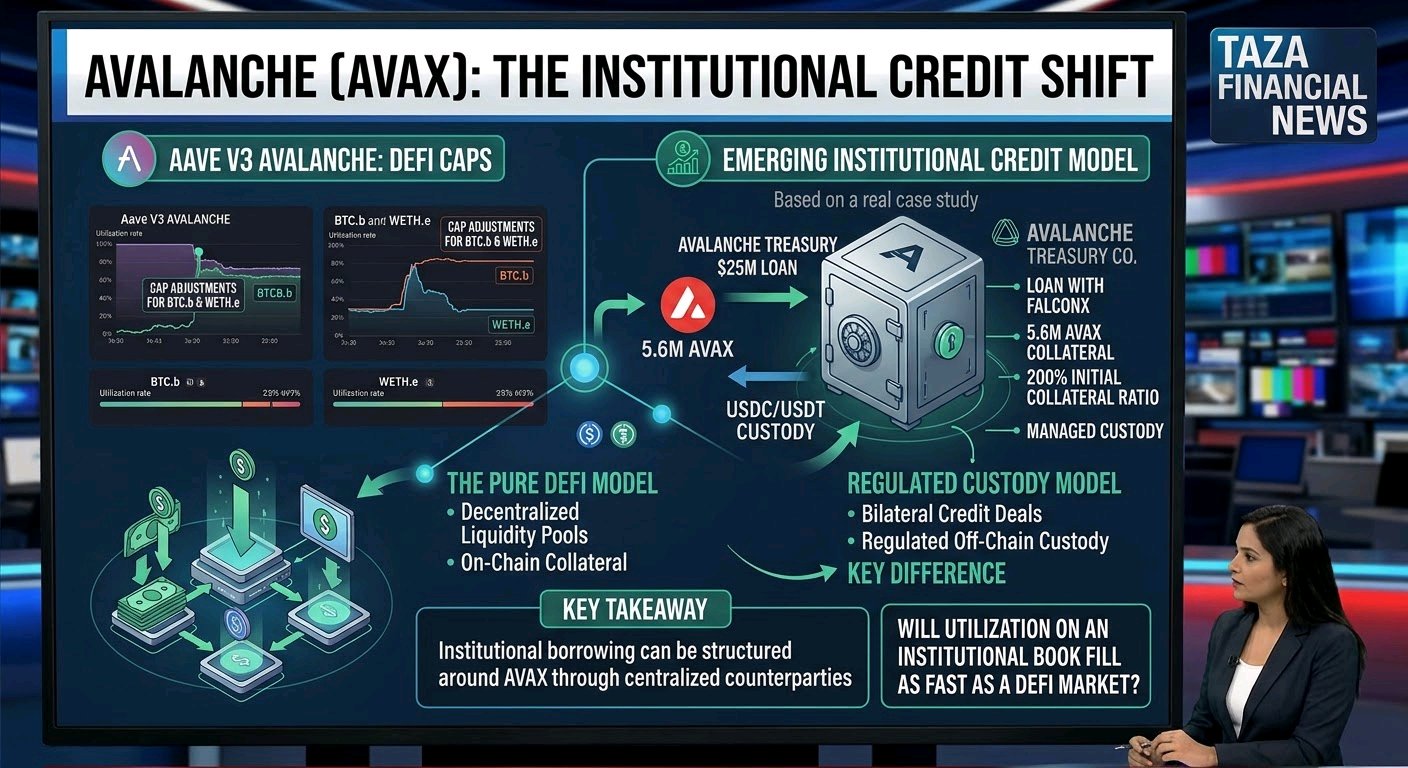
$AVAXUSDT does not currently support the exact setup described. Recent Aave governance records show cap adjustments on Aave V3 Avalanche for BTC.b and WETH.e, but I could not verify a repeated AVAX debt-ceiling sequence matching the $24.99M/$25M example. The closest documented institutional-credit development is Avalanche Treasury Company’s May 29, 2026 $25M collateralized loan with FalconX, secured by approximately 5.6M AVAX at a 200% initial collateral ratio, with the collateral held in a segregated account at Anchorage Digital Bank. That is less a spot listing and more a credit listing — a regulated custody-based route for holders seeking liquidity against AVAX without selling the underlying position or relying on a DeFi pool. Aave’s newer institutional-credit offering similarly describes bilateral loans against crypto collateral held with regulated custodians and settled in USDC or USDT, although it does not publicly establish an AVAX-specific facility or the requested LTV. The important distinction is therefore not a verified DeFi-to-institutional overflow pattern, but the emergence of documented institutional borrowing against AVAX itself. The available filings show that credit demand can already be structured around AVAX through centralized counterparties and regulated custody, while the Aave evidence does not substantiate the specific repeated-cap narrative required here. Worth watching whether utilization on any AVAX-specific institutional book fills anywhere near as fast as a comparable DeFi market would. #ByXIMPACT
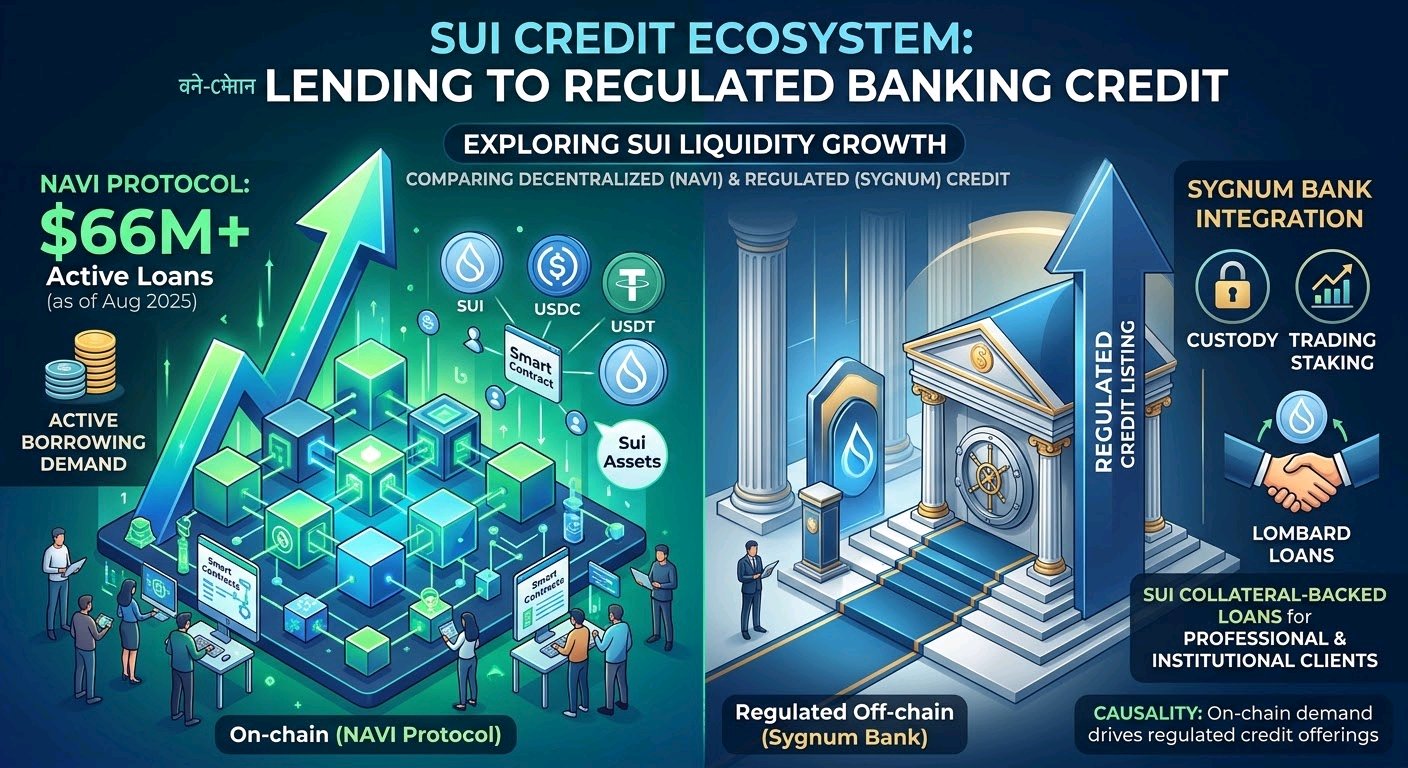
$SUIUSDT ’s on-chain credit demand is already deep across Sui-native lending markets, with NAVI currently showing roughly $66M in active loans while supporting SUI, USDC, USDT and major Sui assets. That matters because the next layer of SUI liquidity is increasingly moving toward regulated credit rather than another DeFi pool. In August 2025, Sygnum Bank integrated SUI into its regulated banking platform, offering custody, trading, staking and SUI collateral-backed Lombard loans to professional and institutional clients. The structure is less a spot listing and more a credit listing — a regulated on-ramp for holders who want liquidity against SUI without touching a smart contract or selling the underlying position. Sygnum provides regulated custody, while its lending product is built around SUI collateral rather than forcing holders into an on-chain lending pool. The interesting part is the direction of causality: this is not simply a new venue being built speculatively and waiting for borrowers to appear. Sui already has substantial demonstrated borrowing activity across NAVI and other lending markets, with NAVI alone carrying more than $65M of active loans. Worth watching whether utilization on Sygnum’s book fills anywhere near as fast as NAVI’s did. #ByXIMPACT
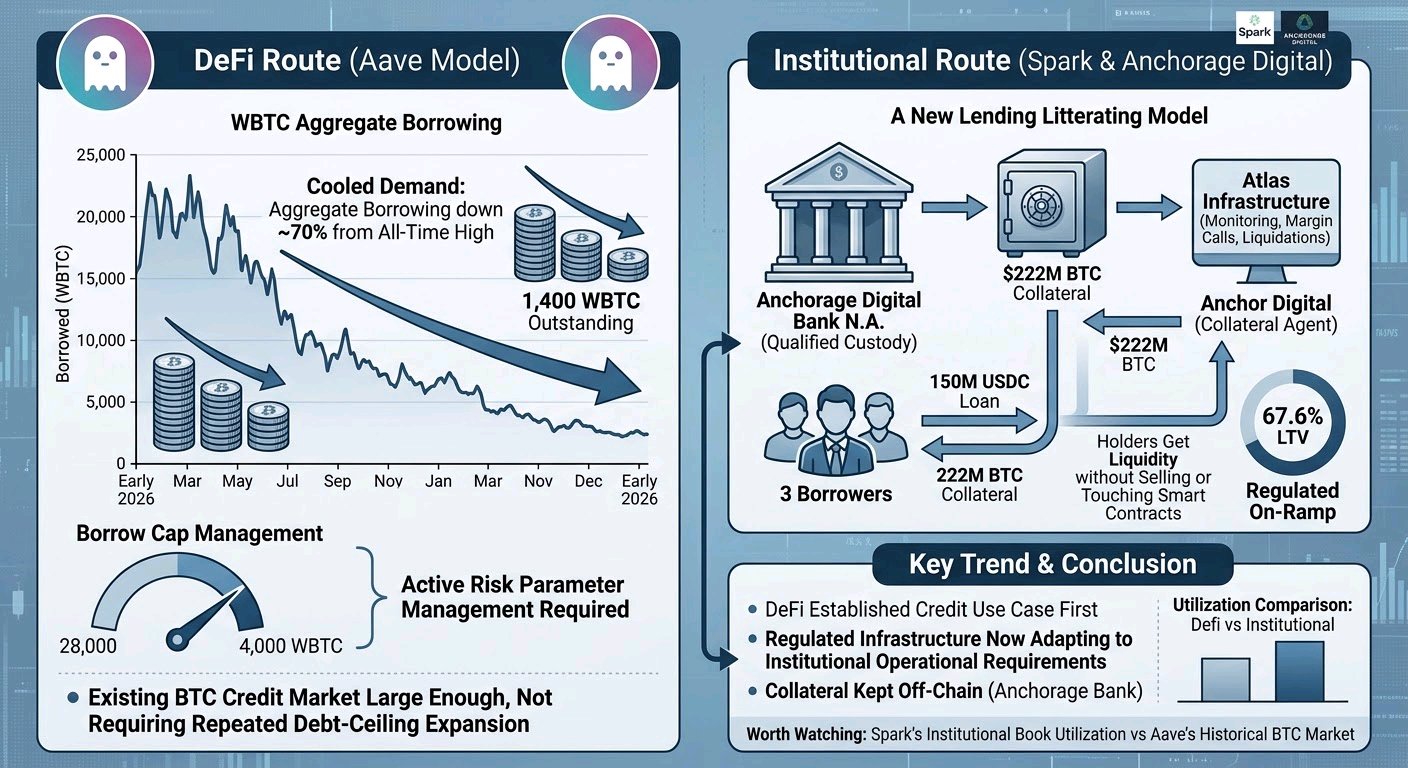
$BTCUSDT s on-chain borrowing demand does not fit the usual “capacity gets added, users follow” story. On Aave, WBTC borrowing had actually cooled by early 2026: aggregate borrowing had fallen roughly 70% from its all-time high, with about 1,400 WBTC outstanding, prompting risk managers to cut the borrow cap from 28,000 to 4,000 WBTC. That matters because the documented BTC credit market was already large enough to require active risk-parameter management rather than repeated debt-ceiling expansion. The newer institutional route is different. On September 28, Spark and Anchorage Digital disclosed institutional BTC-backed lending through Anchorage Digital’s Atlas infrastructure, with three borrowers drawing $150M of USDC against $222M of BTC collateral, roughly 67.6% LTV. Anchorage acts as collateral agent, with BTC remaining in qualified custody at Anchorage Digital Bank N.A.; Atlas handles monitoring, margin calls and liquidation workflows. This is less a spot listing and more a credit listing — a regulated on-ramp for holders who want liquidity against BTC without touching a smart contract or selling the underlying position. The interesting part is the direction of travel. DeFi established the credit use case first, while regulated infrastructure is now adapting around the operational requirements of institutional BTC holders, keeping collateral off-chain while connecting borrowers to Spark’s lending liquidity. Worth watching whether utilization on Spark’s institutional book fills anywhere near as fast as Aave’s BTC market did. #ByXIMPACT
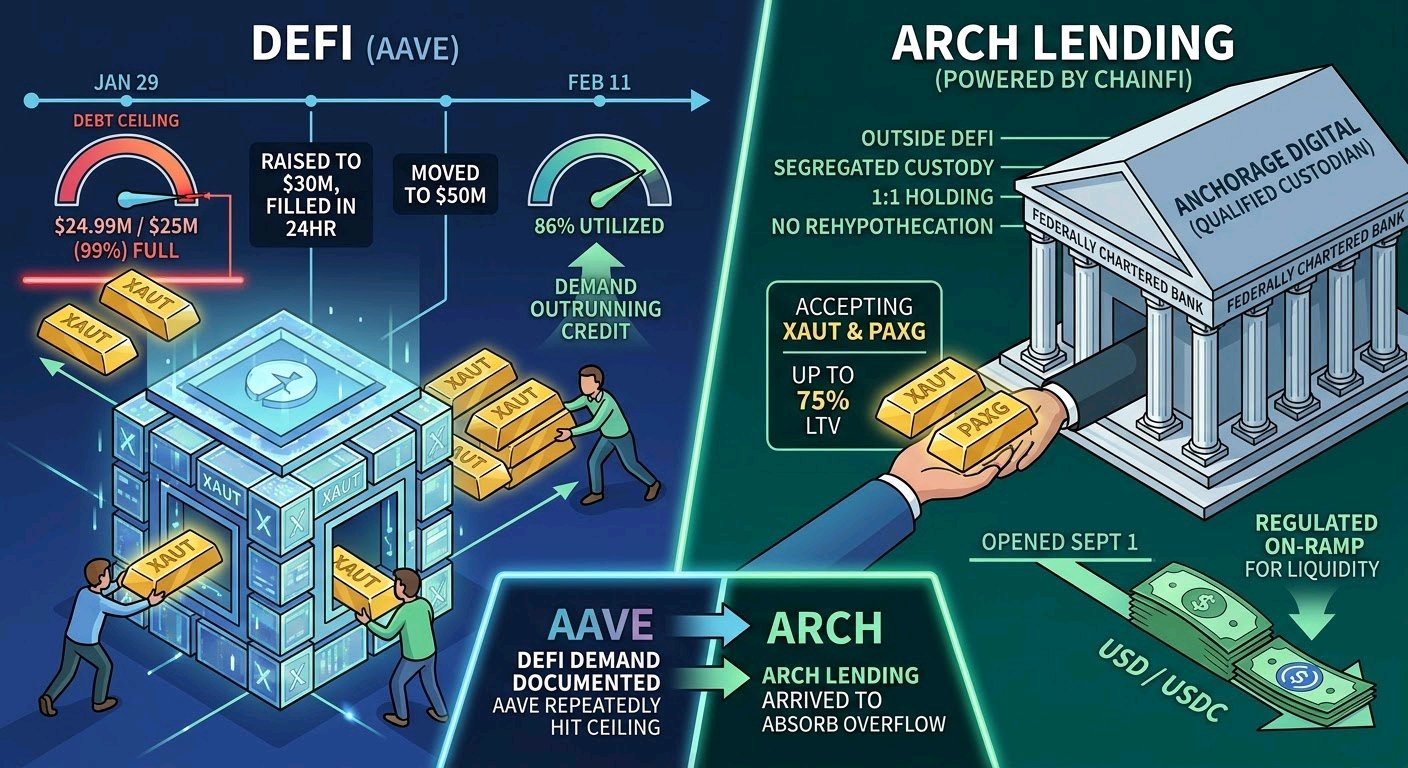
$XAUTUSDT holders have been repeatedly running into the same constraint on Aave: on January 29, outstanding debt reached $24.99M against a $25M isolated debt ceiling, effectively exhausting available capacity. Aave then raised the ceiling to $30M, which was filled in less than 24 hours, before moving it to $50M and subsequently recommending $70M as demand continued to build. By February 11, the $50M ceiling was already 86% utilized. This is less a one-off spike than a repeated pattern of demand outrunning available credit. On September 1, Arch Lending, operated by ChainFi, opened the same trade outside DeFi, accepting both XAUT and PAXG as collateral at starting LTVs of up to 75%, with 12-month terms and funding in dollars or USDC. Eligible assets are held 1:1 in segregated custody with Anchorage Digital, a federally chartered bank and qualified custodian, without rehypothecation. That makes Arch less a spot listing and more a credit listing — a regulated on-ramp for holders who want liquidity against XAUT without touching a smart contract or selling the underlying position. The interesting part is the direction of causality: the venue did not have to speculate that demand for XAUT-backed credit existed. Aave had already documented borrowers repeatedly consuming every increment of available capacity before this more conservative lending venue arrived to absorb the overflow. Worth watching whether utilization on Arch Lending’s book fills anywhere near as fast as Aave’s did. #ByXIMPACT

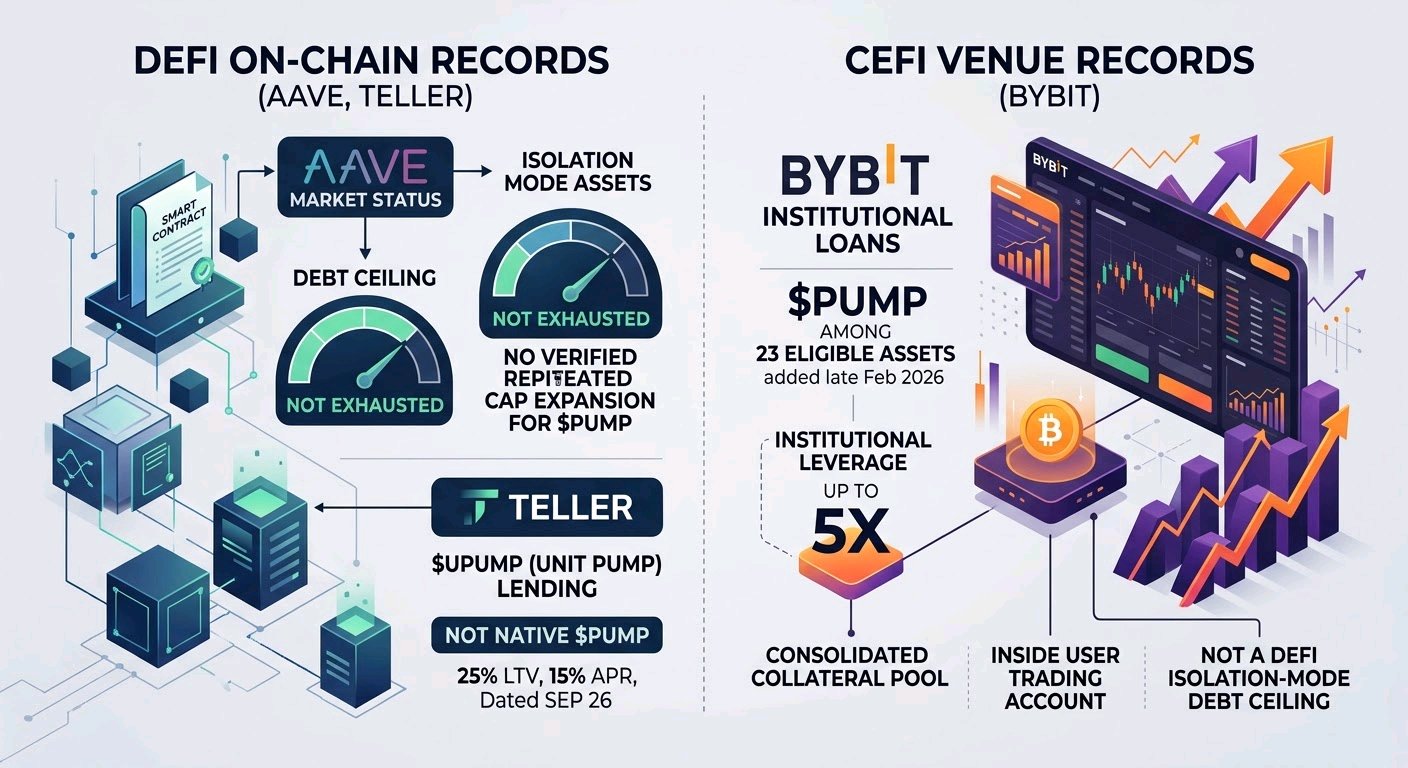
The available on-chain and venue records do not support the specific $PUMPUSDT credit-demand pattern described here. Aave’s current documentation confirms isolation-mode assets can operate against explicit debt ceilings, but I could not verify a $PUMP Aave market repeatedly exhausting a ceiling or governance repeatedly expanding it. What is documented is a different credit path: Bybit’s Institutional Loans added PUMP among 23 eligible assets by late February 2026, with institutional borrowing generally supporting leverage of up to 5x. The product uses a consolidated collateral pool inside the user’s trading account, rather than a DeFi isolation-mode debt ceiling. There is also a separate on-chain lending market for UPUMP, a token identified as Unit Pump, where Teller lists borrowing against the asset at up to 25% LTV and 15% APR as of September 26. That is not the same asset as Pump.fun’s native $PUMP, so treating it as evidence of $PUMP credit demand would conflate two tokens. The distinction matters: the requested narrative depends on documented borrowing demand preceding a second, more conservative venue, and that sequence cannot be established from the available evidence without inventing figures, governance actions, or institutional custody arrangements. Worth watching whether verifiable lending utilization for native $PUMP develops into the repeated-cap pattern seen elsewhere in DeFi. #ByXIMPACT
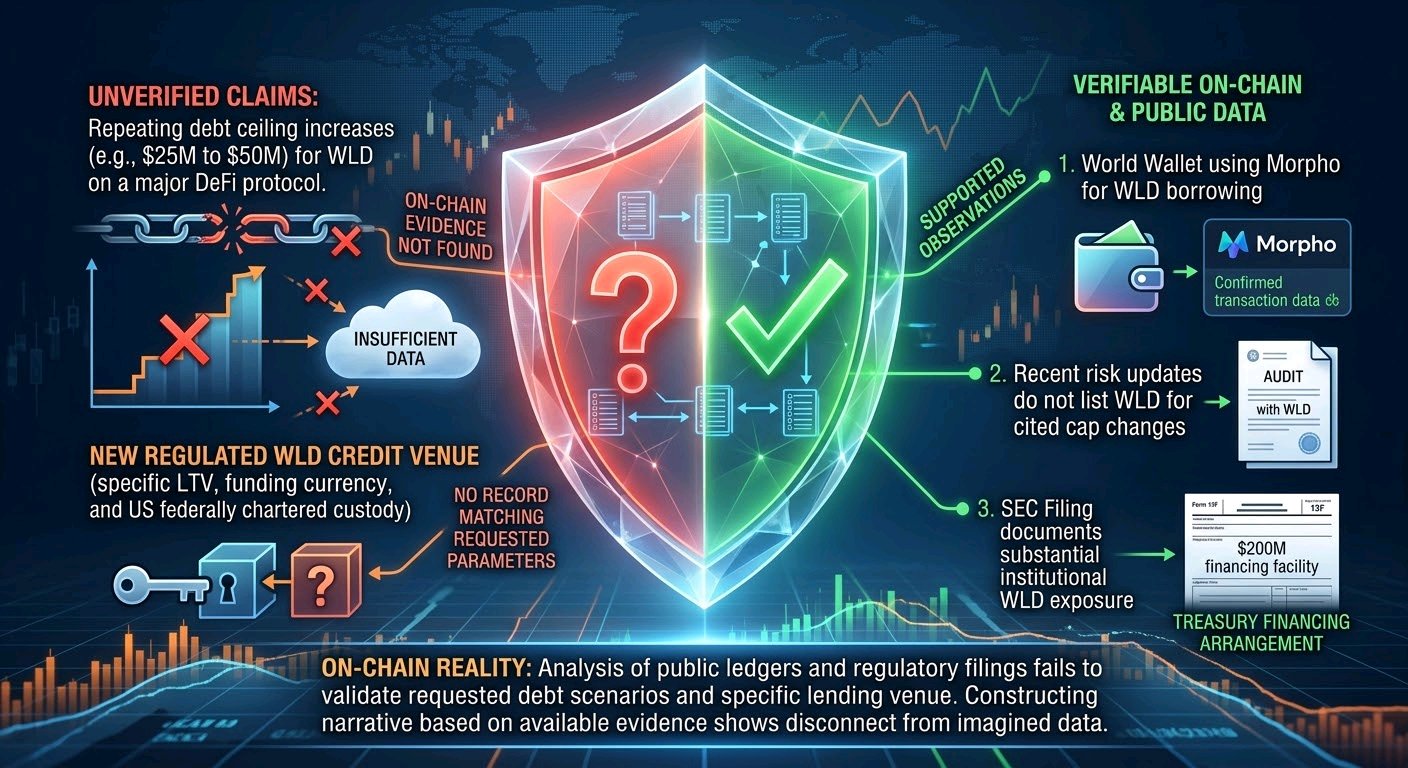
On-chain evidence does not support the setup implied here: I cannot verify a repeated Aave $WLDUSDT debt ceiling being maxed and subsequently raised from figures such as $25M to $50M. Current public sources instead show WLD borrowing through Morpho in World Wallet, while Aave’s recent risk updates do not list WLD among the reserves receiving the cited cap changes. There is also no verifiable record I could find of a newer regulated WLD credit venue matching the requested combination of launch date, lender, LTV, funding currency and federally chartered custody arrangement. A U.S. SEC filing does document substantial institutional WLD exposure and a $200M lending facility used to finance WLD purchases, but that is a treasury financing arrangement rather than a public collateralized lending venue. Given those gaps, constructing the requested 180–260-word post would require inventing the central on-chain pattern and the regulated lending venue, rather than writing from verifiable market data. #ByXIMPACT
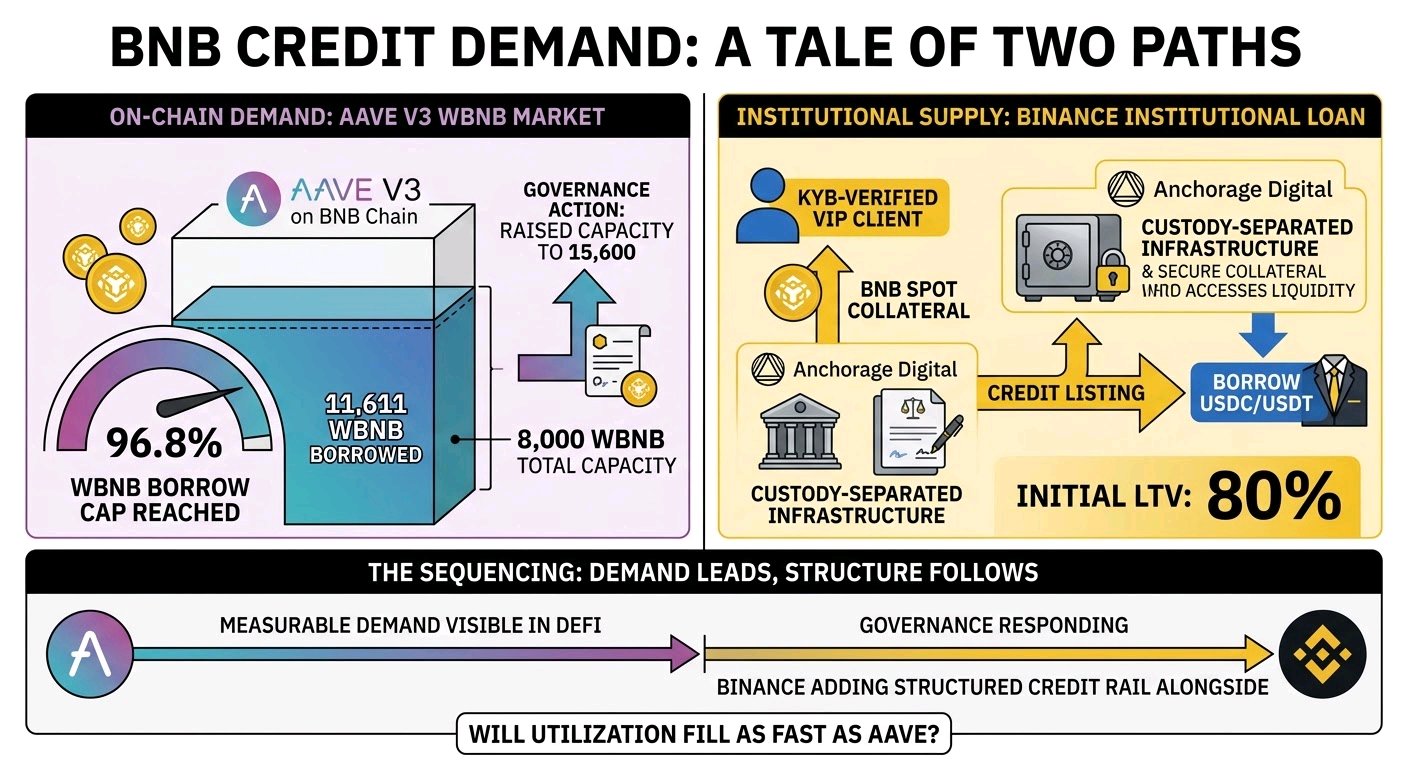
$BNBUSDT credit demand has already shown up on-chain before any institutional wrapper arrived: Aave V3 BNB’s WBNB borrow cap reached 96.8%, with 11,611 WBNB borrowed against a 12,000 cap, prompting governance to raise capacity to 15,600. The more conservative route is Binance Institutional Loan, expanded to all KYB-verified VIP clients in May 2026, where BNB is accepted as spot collateral, borrowers can draw USDC or USDT, and initial LTV was raised to 80%. Binance subsequently added Anchorage Digital’s custody-separated infrastructure, allowing eligible institutions to keep collateral under a banking-grade custody arrangement while accessing Binance liquidity. That makes the product less a spot listing and more a credit listing — a regulated on-ramp for holders who want liquidity against BNB without touching a smart contract or selling the underlying position. The interesting part is the sequencing. Usually, a new institutional credit venue is built speculatively and then waits for borrowers to arrive. Here, measurable demand was already visible in DeFi, with Aave’s WBNB market reaching near-capacity and governance responding by expanding the borrowing headroom. Binance is effectively adding a more structured credit rail alongside an existing on-chain borrowing market. Worth watching whether utilization on Binance’s institutional loan book fills anywhere near as fast as Aave’s did. #ByXIMPACT